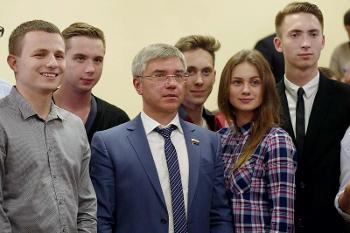

Voronezh State University is a place for discussions aimed at addressing relevant contemporary problems. The university is often visited by media personalities, politicians, and foreign ambassadors.
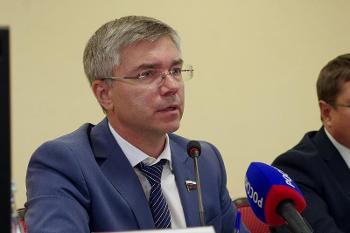
Today, in our university’s conference hall, there was a meeting with a deputy of the State Duma of the Federal Assembly of the Russian Federation, Yevgeny Revenko. An open discussion was held as part of the project named “Students’ discussion clubs: talking as equals”.

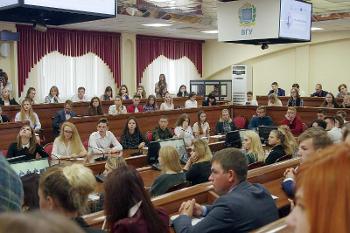
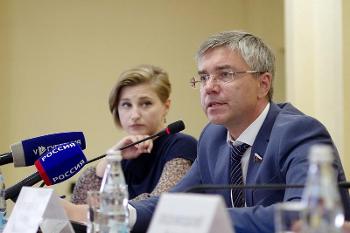
Yevgeny Revenko has visited VSU on several occasions, and this time, he focused on a very interesting topic: How can we fulfil our potential and achieve success? Our guest has first-hand knowledge of this issue, and was kind enough to share his experience with the young audience.
According to Yevgeny Revenko, everyone has their own path to success, and ways of measuring it. Being an elected official, a deputy - does it mean being successful? Everything is relative. Being a deputy means being responsible for a lot of things. It means putting other people’s problems, and happiness, and concerns, above your own. Journalists make good political activists. The reason is that they already possess an important professional trait – they are attentive to other people’s problems.
– I have been a journalist for 25 years. Every day, I would read news, make reports, and talk to large numbers of people. I have been to conflict zones and have attended large-scale events and ceremonies. My first time in a conflict zone was in Chechnya in 1996. Risking our lives, we worked to tell people about what was going on there. I still cannot forget the grief and suffering that I saw. Still, you have to let it all pass through you, and ensure that there is coverage of all the events. It is unbearably hard to witness human pain. Yet, a professional journalist has to be able to do it. We cannot afford to be indifferent, the same way as a politician cannot afford to. Indifference equals professional death, says Yevgeny Revenko.
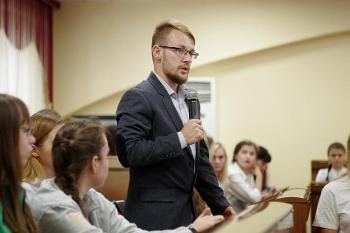
In the modern world, technology holds an important position. We get information from a wide range of different sources – both traditional, such as TV, radio, and print newspapers, and electronic media. Civilian journalism is emerging. There are many sources available, and it is up to a person to choose the source they trust most. Some of the most important sources of information today are social networks and messengers. That is why social networks are gaining significance in all spheres of human activity. Yevgeny Revenko stresses that social networks have recently become a serious platform for making your opinion heard, at the same time allowing you to do it without any “middlemen”, such as editorial boards. It is thanks to this that the connection between government officials and voters is becoming more and more dynamic.



– I am an active user of social networks, where I post notes about my life and work. I do my best to talk to people as much as possible. Access is not limited in any way; you can write to me freely. I also call on my fellow deputies to work actively on social networks. But of course, you can’t make someone talk to people. Some have pages without actually using them; others pay a great deal of attention to their pages. There is a competitive element to using social networks. A politician must be interesting for their audience. You cannot ignore modern means of communication, because then you would be limiting yourself in many ways, says Yevgeny Revenko.
Being bright and open to your audience – those are two of the factors which are extremely importance for one to achieve success. Of course, there are others too. You have to be ambitious and have the will to persevere. “You have to fight in order to win. But in this fight, you have to be fair and follow the generally accepted laws.”