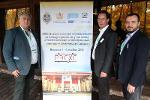

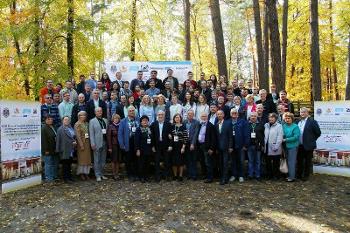
On 1 October, the 23rd national conference with international participants “X-ray Spectra and Chemical Binding” took place in the conference hall of the main university building of Voronezh State University. The conference had representatives from 17 Russian cities from 24 leading universities and institutes of the Russian Academy of Sciences as well as four German and Swedish companies who produce modern equipment for the research of atomic and electronic structures and the physico-chemical state of matter. The event was supported by the Government of the Voronezh Region, Voronezh State University, MC Group, PREVAC Russia, INTERTECH Corporation, SPECS TII Rus, and BLIKFANG.
The theme of the conference is very important as it was dedicated to the shaping of new and the development of the existing local diagnostic techniques for modern multifunctional materials by using unique properties of X-ray radiation, including sources of synchrotron radiation.
The conference started with a welcoming speech by Oleg Kozaderov, the Vice Rector for Research and Innovations, Oleg Ovchinnikov, the Dean of the Faculty of Physics of Voronezh State University, and Evelina Domashevskaya, the Head of the Department of Solid-State Physics and Nanostructure of Voronezh State University.
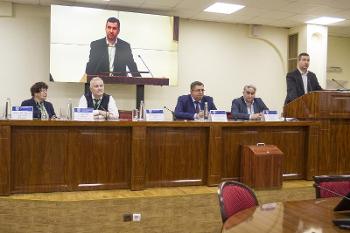

The first talk in the scientific part of the programme was by Mikhail Kuznetsov, the Director of the Institute Solid State Chemistry of the Ural Division of the Russian Academy of Science: “Photoelectron diffraction and holographics as new 3D surface visualisation techniques”.

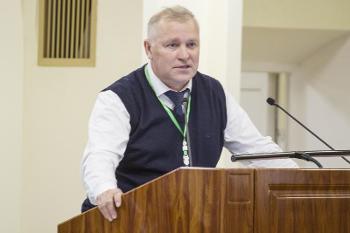
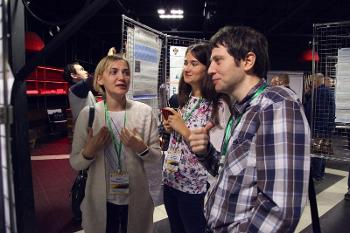
On the second day, the conference continued at the Lesnaya Skazka recreation facility in the Ramon district where participants of the conference spent three days and listened to and discussed 13 plenary, 49 oral, and over 50 poster presentations presented by heads of Russian scientific schools and young beginner scientists.
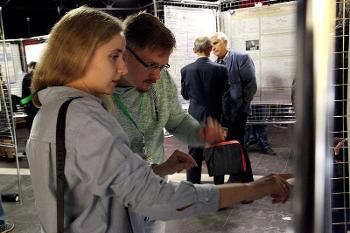
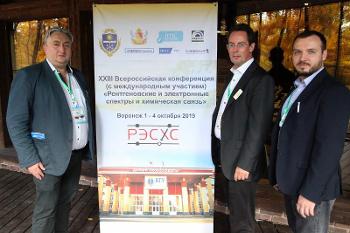
“The conference has been held for nearly half a century that is why it is impossible to underestimate it. Since its beginning we have come a long way from simplest experiments with an X-ray tube to innovative discoveries by using megascience facilities in synchrotron radiation centres. The theme of the conference is very important as it was dedicated to the shaping and development of new and existing diagnostic techniques for modern multifunctional materials by using unique properties of X-ray radiation, including sources of synchrotron radiation. The goal of the conference is to solve fundamental tasks in the field of physico-chemical problems of material studies and to create new functional materials as well as the development of the technology base used to prepare and produce nanomaterials,” said co-organiser of the conference, Evelina Domashevskaya.
During the conference, the scientists also discussed a wide range of problems relating to theoretical approaches and results of comprehensive research of the electronic structure of materials, and the development of laboratory techniques. Also, there were many reports on research of new modern materials: some of them were just problem statements while others presented the results of X-ray photoelectron studies. The groundbreaking ideas presented in this area appeared as a result of the research conducted with the help of megascience facilities of 3-4 generation, i.e. synchrotrons and linear accelerators which have been built and are being actively used in the leading countries of the world.
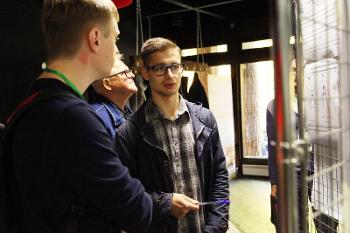
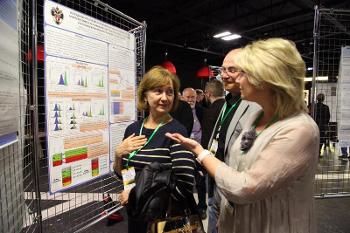
“These techniques are really robust because they are versatile and can be widely used. Today, we tried to gather together scientists who use simpler equipment and scientists who use megascience facilities. We also managed to engage equipment producers so that we could learn first-hand which materials need to be studied to introduce the obtained results into mass production,” said Sergey Turishchev, Associate Professor at the Department of Solid-State Physics and Nanostructures.
According to Sergey Turishchev, one of the most precise methods of material study is X-ray electro spectroscopy, a physical method at the intersection of such sciences as physics, chemistry, and related disciplines. The researchers are focused on the study of the most fundamental properties of materials, i.e. their chemical bonds, composition, and structure. In Russia, such investigations can be conducted by the most recognised scientific schools. Some of them have unique laboratory equipment in Moscow, Novosibirsk, Rostov-on-Don Ekaterinburg, Izhevsk, Nizhny Novgorod, Vladivostok, and Kaliningrad.
“Today, the most advanced ideas in this area are being implemented by physicists from Germany, the USA, France, and Japan, because they have access to fourth generation synchrotrons. We do not have such equipment yet, however, since 2001 we have been a member of a work team in Berlin where there is a facility of this kind. A group of Voronezh scientists headed by Sergei Turishchev have already obtained absolutely unique results. They managed to discover new areas of research of nanomaterials and magnetic materials which have had a great impact on spintronics, nanoelectronics, and the development of biotechnologies. The results of the projects by our physicists have helped to develop the intelligence system “Eelectronic nose” which can detect gases and can give a warning in case of a gas leak. Our scientists also studied the properties of porous silicon which is used to prepare medicine and helps fight cancer and other serious diseases,” said Evelina Domashevskaya.