

Rospatent announced the winners in the nomination “Top 100 of the best inventions in Russia for 2019 and the first half of 2020”. A development by researchers from the Faculty of Physics of Voronezh State University, Larisa Bitutskaya, Andrey Tuchin, Igor Dolgikh, Dmitry Avdeyev, and Tatiana Kulikova, received an invention patent.
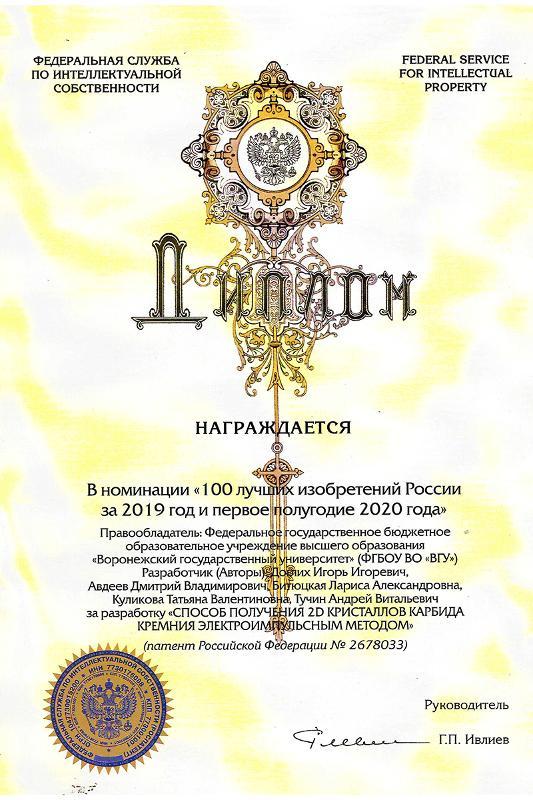
Physicists from our university developed a way to produce 2D silicon-carbide crystals with the help of emulsion technology. A high impulse voltage is applied to a single-crystal silicon-carbide electrode. The destruction of the single-crystal results in the formation of 2D structures which are deposited on the surface of the receiver. As a result, the invention of our scientists allows isolated 2D silicon-carbide single-crystals of 10–50 nm in thickness to be produced. The technology allows to accelerate the production of a single-layer material used in smartphones, laptops, and computer as well as to considerably reduce the production costs.
The unique qualities of nanomaterials are due to their size: for that reason 2D structures were neglected for a long time. The situation changed radically when graphene was invented.
“In 2010, Andre Geim and Konstantin Novoselov were awarded the Nobel Prize in Physics for the production of the unique carbon material, graphene. This gave way to a sudden interest in 2D materials. The obtained patent contributes to the development of graphene technologies. The suggested way of production of silicon-carbide crystals is based on fundamental principles of materials interaction and is resource-saving,” said Larisa Bitutskaya, associate professor at the Department of Semiconductor Physics and Microelectronics.


