Between 20 and 24 of September, VSU will hold Days of Germany. DAAD lecturer Dieter Drawski is to hold an interactive master class “Environment and environmental sustainability in Germany” (21 September). Prior to the Days of Germany, we published an interview with Dieter Drawski.
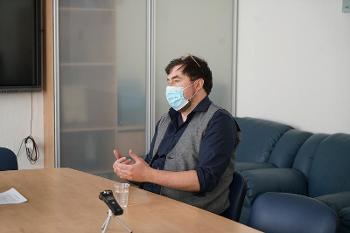
“Why do you think international programmes are important? How can organiser countries and universities benefit from such programmes? What are the benefits for participating students and employees?
“To answer the first part of the question, first of all, it is rational to cooperate in the area of research. If each country conducted research projects on its own, that would retard the progress. If you cooperate and share your knowledge, it is a win-win situation. What is more, science is one of the areas that remains, if not completely then at the very least, less politicised than other areas, for example economics or military science. Another reason is that science is universal. These days, we are in constant contact with other countries and different people and we can fall victims of misunderstanding due to the differences in mentalities. However, science is the same for everyone. The laws of nature are the same, we live in the same world and it is universal. It doesn’t change no matter which scientists are involved, Russian, Chinese, German, or American. We still receive the same results and use the same metrics. In this way, we are so to say belong to the same species. And this is the aspect I absolutely love. If we unite, we will be able to advance and reach our goals faster.”
“And what about universities? What do you think they gain from taking part in mobility programmes?”
“I believe that if universities cooperate and implement academic exchange programmes, they are more attractive both for students and employees. If students know that this university can offer them an opportunity to study abroad, this can be a critical factor for choosing the educational institution to study in.”
“A few days ago, one of our students who had just completed his exchange programme and returned to Russia told us that one of the reasons he had chosen VSU was that it offers opportunities to study abroad.”
“Exactly. As for Germany, we have specialised funds that support such programmes and the universities that take part in them. Of course, high profile research laboratories and libraries can also attract international students and researchers. However, to tell the truth, I can’t think of a good reason to support those who do not implement international exchange programmes.”
“What do you think can be done to increase the popularity of German among Russian students and schoolchildren?”
“I think German is already very popular in Voronezh. We have discussed this with Ludmila Velichkova, the coordinator from the Faculty of Romance and Germanic Philology, and according to her, the number of students who are eager to learn German has significantly increased as compared to other languages. Voronezh has a lot of German companies, which play an important role in supporting the popularity of the language. Those who can speak German have more job opportunities when they graduate.”
“I think it is also important to make more people want to learn about Germany as a whole and about its culture. As far as I know you are one of the organisers of the Days of Germany in Russia. The programme looks quite impressive.”
“That’s right. The event will be held with the support of the German Embassy. We submitted a joint application with our colleagues from Martin Luther University with which Voronezh State University has a long and fine history of cooperation. The research component of the event will be mostly dedicated to research in the area of phonetic studies but we will also have a number of lectures dedicated to history and green economy. I think they will be of interest for a wider audience.”
“Could you advise on or share a secret of mastering a foreign language? It is a well-known fact, that if you know two foreign languages, it will be easier to learn more languages. Yet, do you have your own approach to the problem?”
“Practice makes perfect. Watch TV, YouTube videos, become familiar with the language, and get more exposure to it. For example, I started to study Russian at the university, however, that was just the basics: the alphabet and reading rules. During my first visit to Russia, every time I heard a word I did not understand I asked what it meant, I practised my speaking skills and pronunciation. Yes, you will make a lot of mistakes because it isn’t you native language but we all learn from our own mistakes. If you make a mistake, it helps you get better.”
“It is easier to learn the language in the country where it is spoken. For example, if I want to learn German and I have an opportunity to go to Germany, should I do so?”
“Without a doubt, it is faster and more efficient. In the natural environment you can constantly practice and you have to speak the language if you want to be understood. The main mistake of students taking part in exchange programmes is to avoid speaking the foreign language and to only communicate with students from their homeland. You have to put yourself outside your comfort zone because this is the main barrier on the way to learning and understanding a foreign language.”
“Do you think it is better to start with the basics (grammar and reading rules) or to get used to natural language by reading books and watching television?”
“To my mind, the most important thing is to expand your vocabulary. The more words you know, the more you can understand when you listen or read. You can understand the logic of the phrases. This will help you to understand and remember grammar rules and to some extend you will learn “automatically”. However, this is my way of learning languages, many people prefer a more traditional approach.”


