
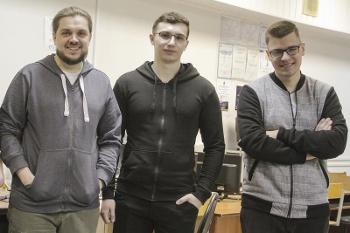
Vladislav Tverdokhlebov and Stefan Shipilov (the programme “Mathematics and Computer Sciences”), third year students at the Faculty of Computer Sciences at VSU, are developing a device that analyses the spectra of cough recordings. The project is led by senior lecturer Aleksey Maksimov. The invention will help doctors to diagnose patients with respiratory diseases and personalise the prescriptions.
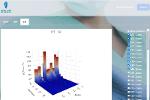
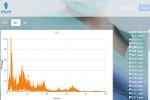
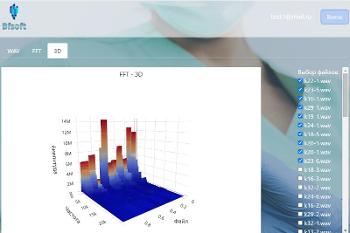
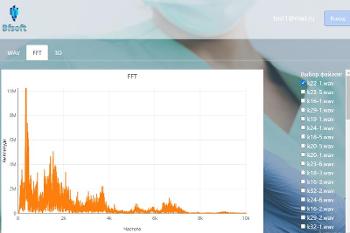
The idea arose when respiratory therapists from the Emergency Medicine Hospital asked the researchers for help. They had a need for the daily monitoring of coughs with audio recordings, which could then be analysed spectrally. A device was needed that could separate coughs from audio recordings, break them down into parts (the so-called coughing acts), and then build their wavelet and Fourier spectra. These transformations make it possible to study the frequencies that are present in sound signals, in other words, high and low sounds. Plotting the distribution of coughs over time can tell experts a lot about the longevity of the effects of a particular medicine on a particular person, and cough spectra can provide information about the patient’s recovery dynamics.
The work is being carried out as part of a cooperation agreement between VSU and the Voronezh State Medical University named after N.N. Burdenko.
“We are working with representatives of the medical university, namely Evgeny Ovsyannikov, DSc in Medicine, to develop a device collecting information about wheezing, coughing, about any respiratory “activity”. Depending on the region of the country and the year in question, respiratory diseases can account for more than 60% of the total disease incidence. That is why we believe that our solution will be in great demand in healthcare institutions,” stressed Aleksey Maksimov.
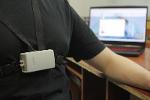
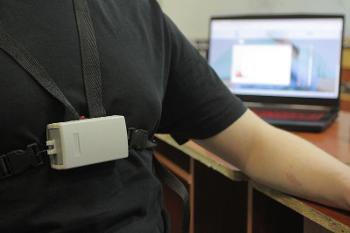
The device consists of a smartphone with a special software, and a small box called a cough monitor. The monitor consists of a respiratory sensor and an accelerometer. This monitor is attached to the person, it analyses the respiration and chest accelerometery data (acceleration during breathing in/out). It helps to distinguish coughing from speech and background noise in audio recordings. The smartphone is used to store and send audio recordings to a remote server where they are analysed.
Doctors receive the data almost in real time and can handle it at any time. How can the data be used? Both the audio recording of the cough and its spectral characteristics can be visualised. By analysing certain frequencies and focusing on the peaks in the graphs, doctors will be able to understand whether a particular medicine is beneficial, or ineffective, as well as the dynamics and duration of effect of the medicine.
For example, a person has asthma: one drug helps for an hour, another makes the patient feel better for five hours. If the patient is monitored for 24 hours, the monitor will analyse cough changes and let the doctors understand which medicine makes the person feel good for a longer period of time.
An invention by researchers from VSU and VSMU will help doctors in the differential diagnosis of respiratory diseases
“We are trying to incorporate machine learning, neural networks that will process audio recordings before doctors analyse them. For example, to determine whether a cough is dry or wet, or to select the fragments of audio recordings that do not contain coughing. If we succeed, we could do without the cough monitor and leave just a microphone and a smartphone. They would record sound in real time, run the records through a neural network, highlighting only the cough and removing everything else. The cough will then be sent to a server. As a result, the system should provide clear graphs and help doctors to make a diagnosis. Currently, we are beta-testing the solution: the doctors are deciding how convenient the system is for them,” commented Aleksey Maksimov.
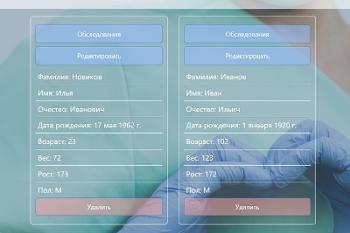
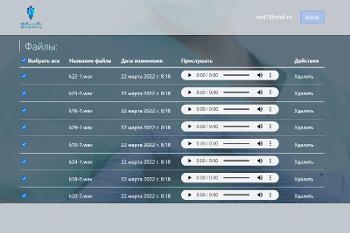
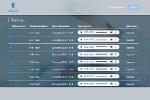
“I did the front-end part, Stefan did the back-end, and we worked together on two issues. I decided how exactly the charts would be built. We needed the charts to be built more or less quickly, without any server-side errors. Since there is a lot of data, the server gets overloaded. We had to split the query into parts: when we select a particular graph or file, only that file sends a query to the server, and then the graph is built. Stefan was responsible for building the database model, that is, he thought through the relationships, localisation, and authentication,” said Vladislav Tverdokhlebov.
“The minimum functionality is already available, now we just need to “spruce things up”. Ideally, it should be a hardware and software system. A person in the hospital is given a special smartphone with software, and within a day, they are living a normal life. We only collect audio recordings of coughs, then we make distribution graphs, spectra, and a doctor draws their conclusions and prescribes some medication,” said Aleksey Maksimov.