Umar Sow is from Dakar, a city in Senegal. He is currently a third-year PhD student at the Faculty of Philology of Voronezh State University. Umar told us how he got to choose his future profession.
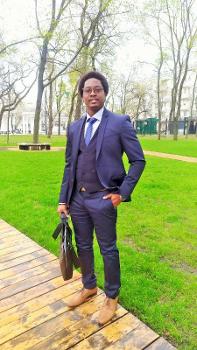
“I’ve always liked reading. I love literature, especially Russian literature. I entered the Cheikh Anta Diop University of Dakar, one of the leading universities in Western Africa, where I studied Russian at the Faculty of Philology. I first came to Russia 6 years ago. It was an internship programme and we worked with international students at the Faculty of Philology.
After the bachelor’s programme, I decided to continue my studies at the Faculty of Geography. But I didn’t see my name in the list of students. I don’t know why, it might have been a mistake, because I had good marks. This is when I accidentally came across my former Russian language teacher. He also studied in Voronezh back in the USSR. And he said to me: “Umar, I submitted an application for you to the Department of Russian Language, so that you can study at our faculty”. This is how I ended up at the university. I got excellent marks in all my classes (I studied three years on the bachelor’s degree programme) and enrolled on the master’s degree programme.
An internship abroad is what every student dreams about. Umar also told us how he got to complete his internship at VSU and the role it had in his future life.
“Prior to the internship, my Russian language teacher went to Voronezh as a member of a delegation of Cheikh Anta Diop University. The universities signed a partnership agreement. Within the framework of this agreement, 6–7 young teachers were to complete their internship in Russia every year. I thought I would go the following year, but my teacher told me: “Umar, in 2–3 months you will be in Voronezh, you need to get ready”. I was so glad! I went to Russia with two girls. After the internship I stayed in Voronezh and they went back home. Thanks to my teachers here I learned a lot about Russia. My teachers wanted me to stay in Voronezh and continue my studies and work here.
I returned home 5 months later. My literature teacher wanted me to enrol on a PhD programme. “You like literature, you should go to Russia again”. Then I met my research advisor who had also studied in Russia, at Moscow State University. For my thesis I studied a novel by Turgenev, Fathers and Sons, and I got an excellent mark for it. I sent my thesis to Russia, and they said it was very good. Then, as I’ve said, there was this partnership between Senegal and Russia. I enrolled on a PhD programme and went to Russia again, to my beloved Voronezh.
My research advisor is Tamara Nikonova, a lecturer at the Department of Russian Literature of XX–XXI Centuries of the Faculty of Philology of VSU. I think being a PhD student is very interesting, but very difficult as well. I didn’t have to attend the pre-university courses for international students by the way. They just told me: “You don’t need pre-university courses, you speak Russian well enough”. So I started my PhD studies immediately.”
PhD students who work on their theses are true heroes. Umar told us what he and his research advisor are working on.
“The topic of my work is “Development of the heroes of our times in the Russian literature at the turn of the 20th century”. We are now analysing the “new people” in the novel What Is to Be Done? by Nikolay Chernyshevsky. We are also focusing on the women characters in The House with the Mezzanine and Betrothed by Anton Chekhov. We are also analysing the character of Pavel Vlasov in the novel Mother by Maxim Gorky. Probably, the most difficult is Vladimir Nabokov's novel The Gift. The theme of the novel is very broad, but we are still trying to analyse it.”
When you are a student, you always find new interests, meet new people, and you feel that life is great. What is being a student for you?
“It’s unforgettable! I’m lucky that I live near the university, so I can get there on foot. At university you get to know a lot of interesting people from other countries. I made some close friends in Russia. I’m a curious person, so I’m always eager to meet new people.”
Work, classes, home – this becomes a routine. Henry Ford said that most people get ahead during the time that others waste. This is Umar’s motto. He only goes home to sleep.
“Besides my work at VSU, I also give private French language classes. I helped three students from the Faculty of Romance and Germanic Philology, we even had online classes.
I always set myself a target. For example, to read 50–100 pages every day, but I end up reading the whole book no matter where I started. I also do sports. I go to the gym and play football with my friends. I just don’t want to waste time. I like my active lifestyle.”
What do you do in order to not lose interest in your work? Umar believes that it’s no good doing just one thing. You need to be versatile. Where does inspiration come from?
“I have a diploma in management, and I work part-time at a restaurant. I want to learn as much as possible. I think it will help me in the future. You can learn your whole life, if you want! When I was on vacation in Senegal, I got a call about people from Bulgaria who wanted to visit Dakar, and they were looking for a Russian-speaking guide. So they asked me to show them around the city. I agreed, of course, because it was a great experience. So they arrived and we got to know each other. They had some kind of a business meeting, they wanted to set up a business in Senegal. We had some nice time together. I showed them some beautiful places and they liked Senegal a lot. We still keep in touch.
Being able to speak Russian in Africa is a great advantage. It’s important to speak fluently and without mistakes, people like it.”
Ivan Turgenev called the Russian language a great, mighty, truthful and free language. But everyone knows that it is also a very difficult language.
“I think my Russian is not very good, but I really like this language. When I was in the 4th form and we started learning Russian, I would always use its letters. Everyone said: “What’s that? It’s a different language! What do you want it for?” But it wasn’t my own decision to learn Russian. The headmaster divided us into groups and I just saw my name on the list. I said that I didn’t know anything about it, but they said it’s a good language and I would be able to learn quickly. There is a saying “Don’t judge a book by its cover”. So don't judge the Russian language until you get to know it.”
Umar says that if he could go back in time, he wouldn’t have gone to university in Dakar, but would have come to Voronezh straight away. You should learn Russian where people speak it.
“Russian is a very beautiful and rich language. It’s the language of Pushkin, Lermontov, and other poets and writers. It is difficult, but still very interesting. When I started teaching Russian, I realised what a great responsibility it is. There are people who have never been to Russia, and they can’t make themselves learn Russian, no matter how hard their teachers are trying. You don’t just learn a language at school or university. You learn a language from the people who speak it. You go to crowded places and listen, learn colloquial phrases, etc. It really helps. If I had known this before, I wouldn’t have entered Cheikh Anta Diop University. I would have gone to Voronezh instead.”
It’s not enough to love a language. You need to make others love it too. To help your students, you need to set an example for them. Umar wants the Russian language to become more popular.
“When I lived at home, I was very ambitious. I said to my colleagues that we should make Russian language more popular among students. I said we should open a Russian language club, where people could listen to Russian music and read Russian literature. I suggested designing a project dedicated to the Russian language. My colleagues said it was a good idea and so I got to teach an intensive course in Russian. And we also opened a Russian language club! When I was at home I did my best to promote the Russian language at my school. We didn’t have many rooms, but when I returned, there were new ones. The headmaster helped us a lot. There are about 10,000 students in Senegal studying Russian now.
The club is also growing. We hold the Day of the Russian Language regularly. I work at the Maurice Delafosse lyceum. We opened a Russian language club together with the Blaise Diagne lyceum. Every year we celebrate the Day of the Russian Language together. Our students sing Russian songs, for example Katyusha. I can sing it myself, I know it by heart, because I love Russian culture. Our students also recite poems by Pushkin, Lermontov, and other Russian poets, dance, and tell fairy-tales.”
Dakar-Voronezh or Voronezh-Dakar? Which way to choose? Based on his professional experience, Umar told us about the difference between students in Dakar and Voronezh.
There is a communication problem in Dakar. Students are not used to speaking Russian with each other. But students of the Department of English Language speak fluently. I even asked the head of the department to find a communication teacher. You don’t need to write in Russian. You just need to speak Russian with students.
Umar says he came to Russia because of his ambitions: “It’s no good when a man has nothing to do”.
“I always work to improve my skills and knowledge. My dream is to be a university teacher.
I would also like to get a certificate as a translator from Russian into French and from English into Russian. I’m a curious person. I like learning new things. I would even like to get a degree in a different area – in international relations. It would be great to work in an international organisation or be an advisor. I’m also learning German, and I can speak a bit of Turkish.
Of course, I get tired sometimes. But it’s no good to just sit and do nothing. You always have to keep moving.”
“To be a good teacher means to love what you teach and love who you teach” (Vasily Klyuchevsky). Umar told us about his work as a teacher.
“I teach Russian as a foreign language. The language we use to teach is French. We first explain new rules in French and then translate everything into Russian. To understand the Russian language you should know it really well (same as French, for example, which is also very difficult). For example, in French, gender is indicated by an article. But there are no articles in Russian. Students sometimes confuse words, because, depending on the gender, they may have different meaning in Russian and in French. So every student has to work it out for themselves! I don’t really like using another language when teaching. I think it’s better to use pictures. This way students understand which Russian word corresponds to the picture. Of course, I have to use French when there are no other options.”
Umar is a strict teacher.
“I ask students a lot of questions during their exams. I treat all students equally at the exams. Professional level is the most important thing. One of my students completed a bachelor’s degree programme. He wrote a thesis on “Time in French, Wolof (one of the national languages in Senegal), and Russian”. It helped him to understand each language. So you need to compare languages all the time, this is how you learn.”
The greatest achievements of teachers are the achievements of their students.
Some of my students have now obtained a master’s degree. Some live in France. Before I came to Russia I had a student, a very good student, who spoke without an accent. He completed a bachelor’s degree programme and went to Paris. He said he was grateful to me because a lot of people speak Russian in Paris. He continued studying Russian at university as a second foreign language. Although he chose a different profession, he keeps learning Russian.”
A simple but valuable piece of advice from Umar.
“I’d say, try to read more. This is what I do. Reading is very important. It’s like time travel. Books will teach you speak well and behave properly.”
CV:
- 2012 – completed a bachelor’s degree programme in Philology; graduated with honours. (Cheikh Anta Diop University, Dakar).
- 2013 – obtained a certificate enabling him to teach Russian language at a lyceum. The best graduate of the Faculty of Science and Technologies of Education and Training (Dakar, Senegal).
- 2015 – graduated from the Massachusetts Institute of Technology (Personnel Management).
- 2016 – completed a master’s degree programme in Philology at Cheikh Anta Diop University.
- 2017 – completed an internship at the Faculty of Philology of VSU (Department for International Students Affairs).
- 2013 – completed a three-month internship at the Blaise Diagne lyceum.
- 2013 to present – teaches Russian at the Maurice Delafosse lyceum.
- 2018 to present – supervises the process of teaching the Russian language in Dakar.
Text by: Rimma Troinikova
Photo provided by Umar Sow


