
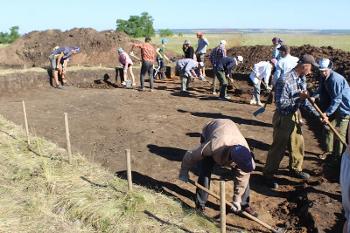
For the first time, a Sarmatian burial site of a high social status with artefacts imported from Rome was discovered in the Middle Don. In July 2022, an expedition of the Department of Archaeology and Ancient History of Voronezh State University excavated burial mound number 24, which is part of a group of mounds near the village of Ivanovka. The excavation of the burial mound embankment was carried out manually by student trainees. Two mutually perpendicular baulks were left to study the stratigraphy. The mound is located on a picturesque foreland formed by the right bank of the Yelan River and the left bank of its tributary, the Tatarka River. After the removal of the embankment, a grave pit of almost square shape, with dimensions of 1.9x2.4 m and a depth of about two meters was found under its top. At the bottom of the grave, along its diagonal, there was a skeleton of a buried adult woman. At the turn of the era, such “diagonal” burial rites were characteristic of the top of Sarmatian society, presumably from the Sarmatian tribe of the Roxolan.
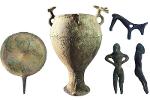
To the right of the buried head, there was a bronze mirror, a mandatory attribute of Sarmatian women's graves. In the south-eastern corner of the grave, there was a large pottery jug covered with black glazing. Near the jug, there was a bronze garment-fastener (fibula). Such fubulas date back to the middle of the second half of the first century AD. A large grey clay bowl was placed near the east wall. It once contained food for the buried.
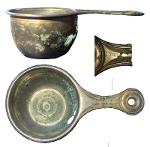
The most interesting finds were discovered near the western wall of the grave. At the bottom, there was a small bronze cast pot with two small handles and a dipper. The mouth of the pot is decorated with cast deer figurines. Most likely, it served for burning incense to remove, among other things, the smell of a decaying body from the grave and to scare away evil spirits.
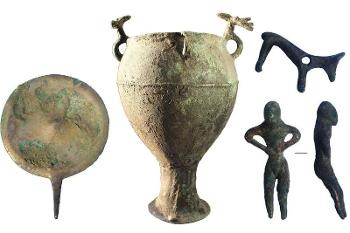
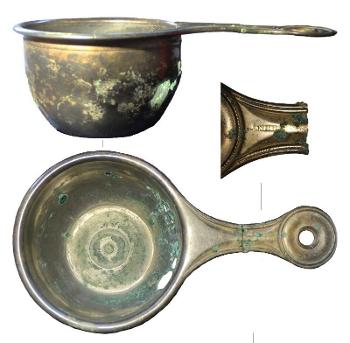
A meaningful find is a Roman dipper made by an Italian craftsman. There is a stamp on the handle with the name of the owner of the workshop, Lucius Ancius Epaphroditus. This name was found on dippers in different parts of the Roman Empire and occasionally in Sarmatia. In our region, a dipper with the stamp of this workshop had been found for the first time. In addition to large finds, the burial site contained: a bronze pendant in the shape of a goat figurine and a figurine of a male athlete with arms akimbo. Most likely, the figurine was captured by the Sarmatians during raids on the Roman Empire and was used as a charm.
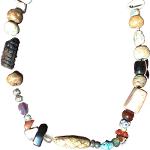
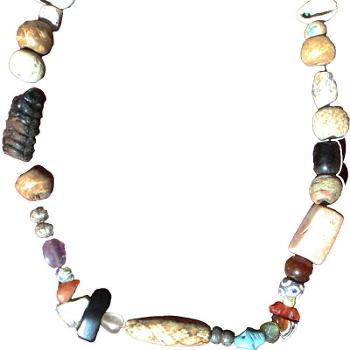
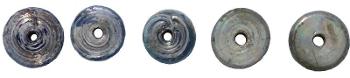
In the Novokhopyorsky burial site, scientists found many beads that differ from previous finds. Each bead is of a special type (instead of usual necklaces of the same type). Only one of the necklaces consists of similar large hemispherical glass beads, whose flat base is decorated with a complex ornament reminding a labyrinth. Around the ankles of the woman’s legs, there were clusters of simple black glass beads of the same type. This is a Sarmatian custom to sew small beads around the top of leather shoes.
“The discovered burial site sheds the light not only on the history and culture of the forest-steppe Sarmatians, but also provides vivid evidence of their strong ties with the Ancient World. This is a new confirmation of the fact that the population of the Middle Don basin belonged to the “Roman Empire – Asian Sarmatia world system”. The discovery marked another curious problem: in the region around the Khoper River, there had already been found five Roman dippers of that time, however, to the east, in the Middle Don, none had been found. Such a concentration of artefacts in one of the most peripheral areas of Sarmatia is unique. To understand this, a detailed study of the materials of the historical monument is required, including with the use of scientific methods. However, it has become obvious that the region around the Khoper River is promising in terms of searching and studying a new group of mounds. We plan to continue excavations in the next field season,” said Professor Alexander Medvedev, DSc in History.
Excavations of mounds have been conducted in the Novokhopyorsky district of the Voronezh Region since 2012.