
Khidmet Shikhaliyev, Head of the Department, told us about the latest projects, the collaboration with the giant company EFKO, and joint projects with the colleagues from Lomonosov Moscow State University and other large Russian organisations.
“Your department does research in many different areas, from the development of plant growth regulators to working with anti-bacterial drugs. How do you choose the topic of your research?”
“Some areas have developed historically and were also oriented towards the main breakthrough fundamental research in the field of organic chemistry. For example, for many years our department has been highly productive in multi-profile research associated with heterocyclic compound chemistry. This class of compounds has been especially popular among the researchers in the past 50 years because they are incredibly diverse and are used almost in all spheres of science and technology. The use of materials and products in all the areas of human activity would be impossible without them. Pharmacology is the area that most depends on heterocyclic compounds. 90% of safe drugs newly recommended by the WHO are heterocyclic compounds with complex structures.”
“And how do you choose new areas?”
“We calculate and offer our competencies, we look for research groups in universities and in the system of the Russian Academy of Sciences that are interested in joint projects. We also search for “contractors” that can test our latest developments and samples and conduct broader and more expensive studies of biological activity as part of the work conducted by our research group according with grants and state scientific and technical orders. If we have both, we start working. For example, we’ve already had a chance to work with a number of large research centres specialising in biological research, such as the Institute of Chemical Diversity, the Physics and Technology Hematology Centre of the Russian Academy of Sciences, and the famous Vector from Novosibirsk. By the way, our colleagues from the VSU Faculty of Medicine and Biology helped us study our latest multi-pharmacoform anti-bacterial drugs.
As for other studies (corrosion inhibitors, detergents products, emulsifiers, and other functional products), we focus on the real needs of our industrial customers and partners. For instance, several years ago we began collaborating with EFKO, one of the largest agricultural holdings in Russia. At that time the company wanted to introduce the non-food commercial activity area and find new methods of applications for vegetable oils. As part of a large state agreement for the development of innovative materials and technologies (amounting to 180 million roubles), we developed technologies for the product line of several compound classes of surface-active substances, emulsifiers, and ingredients for cosmetics and bio-diesel fuel. It should be noted that all these oleochemical technologies are resource-saving and eco-friendly as they are developed in accordance with contemporary “green chemistry” trends.”
“Do you often get requests from large companies that need to develop new substances for their activities?”
“We have been actively collaborating with many manufacturers, and we get new requests for research and development almost every week.”
“How do you choose who you want to collaborate with?”
“As I said, we look at our competencies and decided whether we can cope with the task within the specified time or not. And if we take the project, it becomes successful in 99% of cases, even if our researchers haven’t worked on such developments before. It is sometimes surprising for our customers that our scientific and technical solutions are rather simple. I think this proves the high qualification and professionalism of the employees from the Department of Organic Chemistry who can use simple methods to solve complicated problems.”
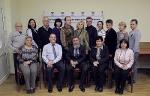
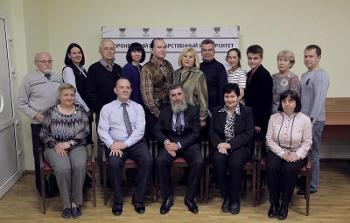
“Judging by the photo, there are a lot of young scientists among your colleagues. Why is your department so popular among them?”
“That’s right, we have a lot of young colleagues. And I’m happy to boasts that all of them except one are my former students. They defended their PhD dissertations and received their DSc degrees under my supervision. All of them. Maybe, that’s also a part of our team’s corporate success.
And it is also true that our department is really popular among students choosing their specialisation or PhD programme. This happens because our students know that we let them show their creativity and share new ideas. The work of most of them is funded by grants and commercial projects, so they get extra payment, which is also very attractive. Even master’s students who receive their specialisation at out department often participate in scientific and commercial research.”
“What about the equipment?”
“Our department has a lot of rooms: there are 19 laboratories at out disposal. It is the biggest number of labs among all VSU faculties.
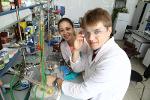
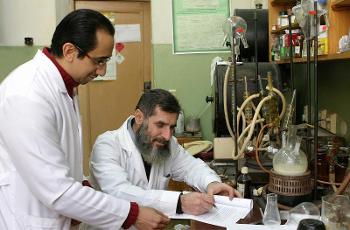
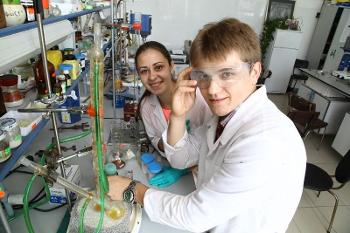
Mostly they are laboratories for organic synthesis with standard “alchemy” equipment: flasks, fridges, glasses and other glass containers. We use classical basic tools that you can find in any other leading universities and academic laboratories.
As for state-of-the-art equipment, we have several multifunctional and universal “reactors” of different volumes (from 100 ml to 10 litres) used for testing and scaling up technological processes that we can offer to our industrial partners afterwards. We also have analysers, I mean mass spectrometer, that we use to determine the purity of substances and their correspondence to the expected structures. In addition to that, we monitor the course of chemical and technological processes.”
“What are you working on right now?”
“On anticoagulants. These substances prevent blood clotting and thrombus formation, which is highly important and relevant for the treatment of many diseases and complications, including post-COVID ones. We have already received two funds from the Russian Research Foundation for their development.
We are collaborating with two research groups as part of this study. One of them is working on docking and quantum-chemical calculations forecasting the properties of the drug using the Lomonosov-2 supercomputer. This group is headed by Vladimir Sulimov from Moscow State University. The second group is headed by Professor Mikhail Panteleev, corresponding member of the Russian Academy of Sciences from the Moscow Research Centre of Hematology of the Russian Academy of Sciences.
The department is very closely associated with pharmaceutics, and we are constantly looking for new research groups.”
“Why is the field of chemical substance study is considered so promising today?”
“I think the reason for that is that reindustrialisation is coming soon in our country, and chemical industry will definitely be reborn because the level of chemicalisation is the headline measure of any industrial and especially post-industrial country.
For instance, the level of chemicalisation in such a widely used device as a smartphone is 85-90%. Even its screen can’t be made without a chemist. Today almost everything people use in their everyday life and in the industrial area is made with the help of our colleagues, so the profession of chemist is in high demand.
Our graduates work at many industrial and research enterprises not only in the Voronezh region, but all over the Central Black Earth Region, and there is no wage ceiling. By the way, many of them work as analysts with chromatographs for input and output chemical product control and are popular specialists in this area. This happens because we provide them with a real work experience with such equipment.
Our graduates also easily compete with the graduates of Moscow and St. Petersburg universities. We are really proud that our graduates have a high level of education and are in demand in many industries and regions of Russia.”
Text by: Irina Golik
Photo: from the department’s archive