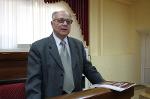
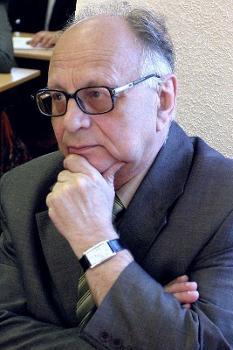
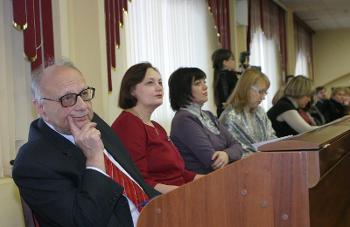
On 25 September Vladimir Listengarten, Rector’s Councillor and a legendary person from Voronezh State University, celebrated his 90th birthday. Being called a “university man” is surely the most honourable title for him. "University man, Vladimir Listengarten": it sounds really dignified. And after so many years it can be said without any doubt that the university had accepted Listengarten into its heart, and this love was mutual. However, telling someone’s love story for them is a highly responsible task. You need a moral right to do that. Let Vladimir Listengarten tell his love story himself.
“Collaboration pedagogics”
I entered the philological department of the Faculty of History and Philology of Voronezh State University in 1950. My cousin Lev Varshavsky had become a student of this faculty two years earlier, after demobilisation. He had great friends among his groupmates who had also fought in the war. They were Boris Krivenko, future VSU professor, Valentin Rakhmanin who later became a famous journalist, and Konstantin Ogryzko who became a local history expert.
We got to know each other even before the classes when we were working on the restoration of the building of the Faculty of Chemistry which now houses the Faculty of Pharmaceutics. We had a great team, everyone was really serious about studying. Our friendship continued after we graduated, and we met every five years. We also got on well with our lecturers who worked in accordance with “collaboration pedagogics”, among them were Sergey Lazutin, Anatoly Abramov, Alla Botnikova, Antonina Abramova. and Polina Borozdina. Sometimes our classes were conducted by talented and enthusiastic postgraduate students Zinaida Popova, Boris Udodov, and Sergey Titov. There was no doubt that we were the most important part of their life as they alwaus found time to talk to us and were interested in communication.
We lived the life of the whole university which was not limited by our group or year. We knew students and lecturers from other faculties. The university wasn’t big at that time, and we attended some lectures together with history students as well as geology and chemistry students. There were 25 people in our group, 25 history students, and 50 geology students. We also had joint classes at the Reserve Officer Training Department. And we printed newspapers, which was very important for us. We had a newspaper of our group called “Komsomol word” and a faculty newspaper “Stalin’s breed”. You can read them and find out what the life of university was like in those times. Problematic issues were covered in these papers, and a lot of people read them.
You can’t give orders at university
During the first year after graduation I worked as teacher of literature and Russian language in a rural school. After that followed seven years in Komsomol, at first in the district committee and then in the regional committee. In 1963 I enrolled on a PhD programme and one year later I became the head of the teaching department at Voronezh State University. I had worked in this position for 33 years. Although before that I’d thought that it was impossible to stay in one position for more than 3 years.
I quickly realised that you can’t give orders at university. Here you should collaborate and always help those who are interested in work. I was very lucky to have really talented supervisors, such as Rector Boris Mikhantiev, Vice-Rector for Academic Affairs Valentin Rakhmanin, and then Petr Gaponov. For example, Petr Gaponov used to say, “University people are so emotional and vulnerable, and if they come to you to talk about some problems, it means they’ve already weighed up all the pros and cons. So you have to treat each request and each problem with a lot of attention.” His words taught me a very good lesson for my whole life.
Every day I come to university because it’s interesting for me. I go to work knowing that I’m going to do some interesting things and talk with people. Everyday meetings and solving problems are not a burden for me. They are something I can’t live without.
“Semper in motu”
Despite all difficulties and complications, VSU continues to grow and develop. And it shows in almost everything. Our university is among the few that have their own scientific history and there are enthusiastic people working on enhancing it. There exists patriotism towards the university at VSU. VSU lecturers and employees understand that science and teaching are closely related.
I think traditions are also very important for VSU. I believe that it's essential to consolidate the achieved success and do not break the line of development, which corresponds to our motto “Semper in motu”. VSU has a strong educational and cultural influence on the urban environment and our region. Active work with schoolchildren, collaboration of university researchers with their partners, numerous publications of our lecturers and employees, and the operation of dissertation boards where teachers from other universities defend their theses and advance their qualifications. The leading positions of our university are recognised even outside our region.
University man
University environment is special. Here you can hear dialogue from various generations. Throughout my work I see, for example, assistants who have been working at the department for a long time, how they treat young lecturers, how they support, help, and look after them. It is not a part of their job. But they are university people for whom the university is like their home and family. It’s a pleasure to be a part of this environment, especially if there is a great researcher working side by side with you, a person who knows a lot and lives for their work. And you conduct this work together with them. It’s just great!
Natalia Valter