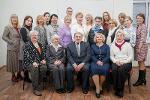

The Faculty of Romance and Germanic Philology was founded 60 years ago. How did it all start, how has it changed, and what is it like today?
The order to begin training Romance and Germanic philology specialists was signed at VSU on 8 July 1960. At first, there was a part-time course at the VSU Faculty of Philology, and then it turned into full-time training for future teachers of English, German, and French. In 1961, Spanish and Literature courses were added. And in 1962 the eleventh faculty of VSU, the Faculty of Romance and Germanic Philology, was created by the order of the Ministry of Higher and Vocational Secondary Education of the RSFSR.
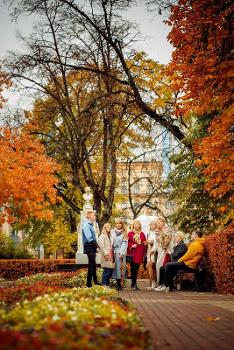
“The foundation of the Faculty of Romance and Germanic Philology was highly important in 1960s, the decade that was later called the “Thaw” period. It was a time of important reforms in the educational and scientific systems as well as the expansion of international contacts in the field of literature, art, sports, and the youth movement. The new time required new specialists that could not only read and understand texts in foreign languages but also write and speak fluently, provide high quality translation and interpretation, and effectively strengthen international contacts. It required broad-minded people with high levels of thinking and philological knowledge who knew the most progressive methods of teaching foreign languages. Our faculty has been successfully training such specialists for the past 60 years,” said Olga Boriskina, Dean of the Faculty of Romance and Germanic Philology.
This is how the faculty which trains linguists, translators, and teachers was born. It is not an easy task to train modern specialists while following the latest trends in the cultural context of other countries and language changes.
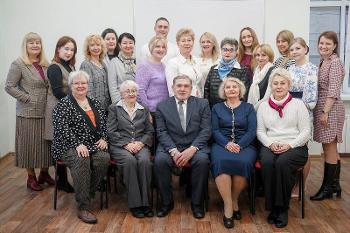
The faculty building is like Hogwarts. Everybody know about it, even those people who have never been inside. Some rooms of the first floor can only be accessed if you go down certain stairs from the third floor, so if you are new here and take the wrong stairs, you can be late for your class. It takes some time to learn all the access ways. What if the stairs really move here? If it is so, nobody would be surprised. The faculty is actually a lot like a fairy tale medieval castle because here you can get a “train ticket” to new wonderful lands (sometimes quite literally since students often have internships in other countries): their traditions, life, and language. This miracle island of international culture exists right in the centre of Voronezh.
“The Faculty of Romance and Germanic Philology opens the world for you. Students can study several foreign languages and have a unique possibility to study in prestigious international universities obtaining new values and great experience of communication practice and promoting their native language and culture. The faculty lecturers also advance their qualifications, share their experience by taking part in international conferences, seminars, and forums, and establish and strengthen contacts with international colleagues in order to create new programmes and improve the existing ones. The faculty is a live and constantly developing organism, bright as Spanish fiesta, delicate as French fashion, expressive like Italian art, and at the same time displaying the features of German meticulousness,” noted Yulia Pustovalova, a lecturer from the Faculty of Romance and Germanic Philology.

Everything is a bit different here: you can choose subjects for your thesis paper such as issues of translation related to your favourite TV series; students know all Latin cases and can even translate from Latin, and in language practice classes they talk about things that are not usually associated with studying, such as their favourite films and books, friendship, and current world problems. Yes, they can talk about it with their teachers. But on one condition: they must talk in the language that they study. There is even a subject called Reading in which you can spend time together with your teacher and classmates discussing the ethics of the behaviour of characters in Somerset Maugham’s works.
“What I have always enjoyed about the faculty is the atmosphere of creativity when lecturers invent some new methods of introducing some specifics of culture to students, when they share their personal impressions and focus on students’ interests. And students, in their turn, don’t just study the language and master theoretical courses but they also look at what’s interesting for them outside the university through the prism of linguistics and intercultural communication theory. I think it’s great when the chosen specialisation is not only about classes and preparation to them but when it also affects various areas of people’s lives and helps to create a more ordered worldview.
Today the faculty includes eight departments and two research centres, the Centre for Phonetic Studies and the Centre for Computer Linguistics. The faculty offers the following educational programmes: Bachelor’s degree programmes: Fundamental and Applied Linguistics, Theory and Methodology of Foreign Language Teaching, Intercultural Communication Theory and Practice, European Languages and World Literature; specialist’s degree programmes: Translation and Translation Studies; master’s degree programmes: International Business Communication and Translation, Foreign Language Teaching with the Application of Online Technologies, Linguistic Support for Project Activities in International Cooperation; postgraduate programmes: Linguistics and Literary Studies. There are also additional programmes where students can learn Portuguese, Arabic, Chinese, and Japanese.
“While studying at the bachelor’s and master’s degree programmes at the VSU Faculty of Romance and Germanic Philology, I learnt the necessary theory and obtained sufficient practice of interpretation and translation as well as the knowledge that broadens your mind enough to become a translator. Lecturers share their personal experience of translation activities thus preparing us for real work. Through their responsible approach and sincere love to what they do they inspire us to develop for the sake of our profession. Studies develop the required practical skills and the ability to stay focused in difficult situations, process information quickly, and learn new things. Now I work as an interpreter and translator and I often use the knowledge and skills that I obtained at university,” said Nikita Isaev, a graduate of the Faculty of Romance and Germanic Philology.
Over the past 60 years, many students have graduated from the faculty and each of them has chosen their own professional development. Some translate subtitles for cinema festivals, some pass their knowledge to their own students while others do technical translations or translate fiction that we like to read on winter evenings. There are many different options to choose from but all future professionals started from here, VSU building No. 2 in 10 Ploschad Lenina.
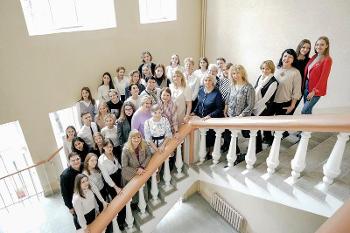
“The Faculty of Romance and Germanic Philology is especially proud of its graduates. Among them are scientists and teachers, diplomats and journalists, writers and translators, heads of joint international enterprises and organisations, as well as employees of security services. These are just a few people whose names are well-known by specialists involved in various aspects of intercultural communication: Vladimir Titov, DSc in Philology, Soviet and Russian linguist, rector of VSU from 2006 to 2010, VSU Professor Iosif Sternin, DSc in Philology, Russian linguist, Vyacheslav Kashkin, author of more than 200 scientific and educational works published in Russia and abroad, Viktoria Safonova, DSc in Pedagogics, Soviet and Russian linguist, culture expert, teacher, specialist in foreign language education methodology, Emilia Komarova, DSc in Pedagogics, Russian teacher, Professor at the Department of Foreign Languages and Translation Technologies of the Voronezh State Technical University, Full Member of the International Teacher’s Training Academy of Science, Professor Viktor Koprov, DSc in Philology, Honoured Worker of Voronezh State University, Professor Elena Belyaeva, DSc in Philology, Dean of the Faculty of Romance and Germanic Philology from 1988 to 1995. The 60th anniversary shows that all aspects of the faculty’s activities aimed at the preservation and augmentation of the underlying traditions are being dynamically developed.
The faculty offers its students a ticket to an interesting life full of career takeoffs. The train from the platform of the Faculty of Romance and Germanic Philology leaves every year on 1st September.
Text by: Ekaterina Kochetova
Photos from the archives of the VSU press-centre and speakers