
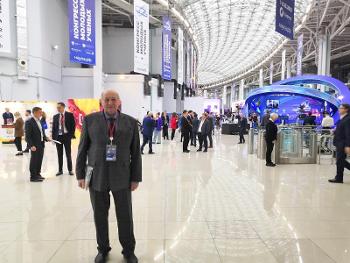
From 1 to 3 December, the 2nd International Congress of Young Scientists was held at the Sirius University of Science and Technology (Sochi). Professor Semion Kurolap, Dean of the Faculty of Geography, Geoecology, and Tourism at VSU, attended the event. The professor was a guest speaker at the round table “Global Challenges and Sustainable Development of Territories: Balance of Natural and Anthropogenic Systems”.
The participants of the round table were major public leaders and state officials of Russia, as well as internationally renowned scientists: Aleksandr Klimenko, Chairman of the Expert Council of the Presidential Programme, Aleksandr Khlunov, Director General of the Russian Science Foundation, Elena Shmeleva, Head of Educational Foundation “Talent and Success”, and Sergei Gulev, Head of the laboratory of the Shirshov Institute of Oceanology of the Russian Academy of Sciences.
At the round table, participants discussed current research, education, and application in the fields of ecology and climate. The discussion revealed that the current human-induced environmental and climate changes are truly global and must be monitored and managed. Despite significant progress in the study of climate change and environmental impacts, many questions remain unresolved. This highlights the issue of establishing an International Research Centre for Ecology and Climate at Sirius University in line with the President’s instructions and the current strategic directions of the Environmental Security Strategy of Russia.
“VSU is willing to cooperate. The university has all the necessary capacities to develop scientific research and educational programmes in the fields of ecology and climate. These activities and programmes can be implemented using the hydrometeorological observatory of the Faculty of Geography, Geoecology, and Tourism. The main areas of educational and research studies of the proposed international scientific and educational centre may include urban microclimate studies, monitoring of anthropogenic pollution, as well as medical and environmental aspects of public response to global and regional climate change,” commented Professor Semion Kurolap, Dean of the Faculty of Geography, Geoecology, and Tourism.


