11 February 2023 was the 110th anniversary of an outstanding scientist, professor Anatoly Shatalov, DSc in Chemistry, founder of the Voronezh school of electrochemistry, and Head of the Department of Physical Chemistry of VSU in 1956–1979.
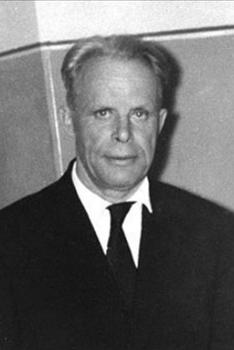
Anatoly Shatalov was born in Saint Petersburg in 1913. He graduated from the Faculty of Chemistry of VSU in 1937. Being a PhD student (1939–1941), he conducted his first studies in the field of electrochemistry and the corrosion of metals under the supervision of Nikolay Kultashev. However, during the WWII he had to stop his research and could only resume his studies as an associate professor at the Department of Physical and Colloid Chemistry in 1950. In 1955, he defended his DSc thesis at the Institute of Physical Chemistry of the Russian Academy of Sciences. In his thesis he used the principles of electrode kinetics to describe corrosion processes.
In 1956, Anatoly Shatalov was appointed first a professor and then the head of the Department of Physical Chemistry. Starting from this point, the department was focusing on the problems of electrochemical corrosion of metals, electrochemistry of ion exchangers, and membrane electrochemistry. Anatoly Shatalov was a very educated man, a wonderful lecturer, and an outstanding expert in physical chemistry and electrochemistry. He managed to conduct state-of-the-art research despite the limited technologies available at the time.
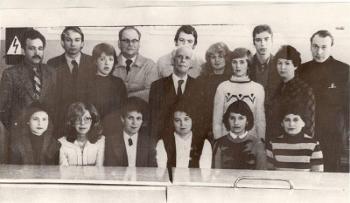
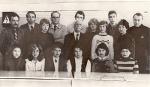
Department of Physical Chemistry headed by professor A.Ya. Shatalov (in the middle)
“It was at that time that the basis of all the scientific areas currently developed by the Department of Physical Chemistry were set. It was also the time, when the department started training specialists who then developed the Voronezh school of electrochemistry and corrosion studies”, said Oleg Kozaderov, Head of the Department of Physical Chemistry.
“Thanks to his scientific authority, Anatoly Shatalov became the chairman of the country’s Mani Committee on Physical Chemistry. Being a vice-rector, he coordinated research in the whole university. He also gave lectures on physical chemistry for students of the Cairo University in Egypt for two years. Being a man of great scientific sophistication and innovative mindset, professor Shatalov always managed to implement his ideas.”
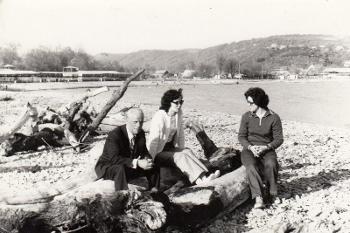
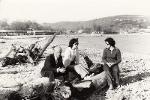
Professor A.Ya. Shatalov together with E.I. Ivakina, PhD in Chemistry, is listening to a rehearsal of a report by his PhD student O.V. Bobreshova (“Electrochemistry of ion exchangers” conference, Dxhubga, the Krasnodar Territory)
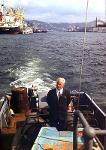
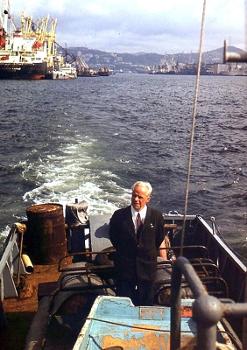
“He supervised the whole series of scientific and research and development projects in electrodialysis demineralisation of various aqueous media: pickle liquor at semiconductor production enterprises and waste water from various industries. The results of these studies were successfully implemented in the nuclear power industry and by several electronics, chemistry. And food industries. Thus, the electrodialysis machine for obtaining service and drinking water from see water developed under his supervision was effectively used in Vladivostok on a whale factory ship “Soviet Russia”, said Professor Olga Bobreshova, a student of Anatoly Shatalov. Professor A.Ya. Shatalov on board of a whale factory ship “Soviet Russia” (Vladivostok)
Professor Vladimir Shaposhnik remembers the times when he participated in scientific conferences together with Anatoly Shatalov:
“A scientific conference is a finishing line of a long period of work. They give you a better image of scientists than their everyday work. Watching Anatoly Shatalov at large national and international conferences I could see how quickly he reacted to the information in other presentations, asked relevant questions, and always joined discussions following each presentation. This is a very rare gift.”
“My teacher is Anatoly Shatalov, DSc in Chemistry, professor, Head of the Department of Physical Chemistry of Voronezh State University. Behind this brief description there is a life of one of the brightest scholars of chemistry. He conducted basic research in electrochemistry of the corrosion of metals, alloys, and ion-exchange membranes. He also initiated the studies of metal-ion exchanger nanocomposites, which are a priority area at the moment. When I came to my first lecture in physical chemistry and heard Anatoly Shatalov, I knew it was my fate. I dedicated my whole life to physical chemistry, which is a unique science with regard to its logic, elegance, beauty, and importance. Studies of physicochemistry of nanocomposites, which we developed, have become a new field recognised both in our country and internationally. Anatoly Shatalov, besides being a great scientist, also was a man of great culture. I still can’t help admiring his drawings and letters, as well as his knowledge of literature, music, and art”, said Professor Tamara Kravchenko.
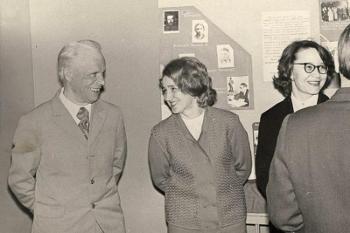
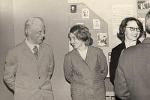
Professor A.Ya. Shatalov and T.A. Kravchenko
“Anatoly Shatalov was for all of us an example of a very talented and balanced man, who had fundamental knowledge and a great ability to express himself. He was also a great artist and had a good taste in music. These qualities naturally influenced the young people, who always surrounded him both at university and at home, or in his garden, which he cherished greatly (especially the wonderful rosary!). I knew him since 1958. First, he was my research advisor, when I worked on my undergraduate thesis and PhD thesis. Then a worked as a lecturer and an associate professor at the department he headed. Over those years I observed him as a great teacher, who knew how to train young specialists. The department organised regular workshops on electrochemistry and the corrosion of metals - the two fields developed by A.Ya. Shatalov at Voronezh State University. The latter field includes “The theory of anodic oxidation of metals and semiconductors”, “The theory of corrosion macrocouples”, and, starting with the 1960-s, “Electrochemistry of ion exchangers” and “Electrochemistry of membranes”. I think those workshops gave me a lot for my further scientific studies and teaching. I’m extremely grateful that I had such wonderful advisors, Anatoly Shatalov, a theoretician and Vladimir Marchakov, a practician”, said Professor Svetlana Kaluzhina.
“Anatoly Shatalov passed away almost 38 years ago, but his charm is still here. He is one of the most outstanding, talented, and gifted natural scientists of our region, but he is well known far beyond its borders. Professor Anatoly Shatalov was my research advisor for my undergraduate and PhD theses. When I became a PhD student, he asked me: “Which field do you want? An old boring “wife”, like corrosion, or a young “mistress”, like the electrochemistry of ion exchangers?”. This is how I started working on the thermohalvanic corrosion of stainless steels. Anatoly Shatalov always thought strategically, he sensed all the innovative areas in science. He continued the traditions of the Imperial Yuriev University and founded several modern fields of study in physical chemistry and electrochemistry. Thanks to Anatoly Shatalov, the Department of Physical Chemistry became the leading department of the Faculty of Chemistry. Anatoly Shatalov was a great scientist and teacher. Being a gifted person, he has many interests: music, literature, art (VSU held several exhibitions of his works), winter swimming, chess, etc. He was also a very charming man of outstanding personality. A man who was hard to forget!” said Professor Larisa Belchinskaya.
“Yes, Anatoly Shatalov was a very unusual, very interesting man. He dedicated his whole life to Voronezh State University. The university was his life. It is important to preserve his legacy and develop it”, said Anatoly Shatalov’s daughter, Margarita Vasilevskaya, PhD in Chemistry.