

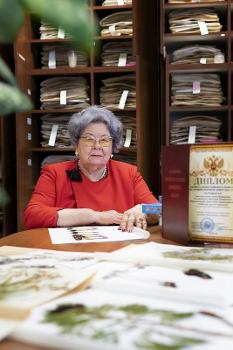
DSc in Geography Anna Ya. Grigorievskaya has been at VSU for six decades. Out of these years, for more than twenty years she worked in the "Galichya Gora" nature reserve and also served as the director. Today he teaches at the Faculty of Geography, Geoecology, and Tourism and is a professor of the Department of Geoecology and Environmental Monitoring. Founder, collector, and custodian of the VORG herbarium of the Faculty of Geography, Geoecology, and Tourism. Before the anniversary of Anna Yakovlevna, we talked with her about the most important things over the years.
“Anna Yakovlevna, you are from Belgorod, how did you end up in Voronezh?”
“I was born in the Krasnogvardeisky district of the Belgorod region. Well, how I ended up here... I arrived in Voronezh and entered the correspondence department at the Agricultural Institute. Latter I realized that the specialization in which I studied did not quite correspond to my interests. Then I transferred to the Faculty of Biology and Soil Sciences (now known as the Faculty of Biomedical Sciences – P.P.) of VSU. They transferred me to the full-time course during the second semester of the third year with the condition of elimination of academic debt for a year and a half and without the right to receive a scholarship.”
“Why in that case you were not transferred to the second year?”
“There were simply no places.” “It was such a busy course?” “Well, yes – all the places on the course were filled. But I did it.”
“ How did you become involved with Galichya Gora?”
“I was sent to work there: from January 1965, while still a student, I began working as a half-time laboratory assistant at the Galichya Gora Agrobiostation of Voronezh State University. I was enlisted to work as a laboratory assistant since August 1, 1965.
Sergey Vladimirovich Golitsyn, a famous botanist and specialist in the flora of the Central Russian forest-steppe, worked at Galichya Gora at that time. The topic of my research work was "Flora and vegetation of the Galichya Gora". In 1973 I defended my PhD thesis.
The living conditions at Galichya Gora were difficult. Water was brought in a barrel from the village of Donskoye. Sometimes there was no water, and it had to be taken from the Don. This water was boiled and used for food. However, this fact shows the ecological situation at this time – a lot has changed since then...
After collecting the material in the summer, the researchers returned to Voronezh to process the material at the department. I stayed in the winter on Galichya Gora. At that time, there was no housing there. The winter was cold and terrible. I had one dog with me and no one else. All day long I kept the stove going. In the small room the temperature was plus twenty eight at ceiling height and on the floor the temperature was minus two. There was no coal, only firewood. I chopped them myself. However, all the difficult moments were replaced by work and all sorts of responsibilities.”
“When you became the director of the reserve, did something change?”
“Galichya Gora was assigned the status of a reserve at Voronezh State University in 1967. It turned out to be the only nature reserve in the country as part of the university system. The struggle for Galichya Gora was hard. For example, there was a discussion about changing its governance. The culmination of this struggle was at the time when Nikolay Alekseevich Plaksenko was the rector of VSU. He made it clear: Galichya Gora will remain at the university.
It was a hot topic: they involved the ministry who came and performed various checks...
Design documentation was developed for the construction of seven power lines through the territory of the reserve. They were supposed to provide power to Lipetsk Magnitogorsk (Novolipetsk Steel Works. – P.P.). We were saved by the fact that the design organization, which was located in Kiev, made a number of mistakes in determination of the location of electrical poles. But one pole was still installed.
Project documentation was also prepared for the construction of a recreation centre at a distance of one kilometre from Galichya Gora.
Nevertheless, we defended the reserve, convincing the management that regular excursions would not allow us to save this "relic paradise".”
“How did the employees of the reserve live at that time?”
“In the first years we lived under difficult conditions. Other conditions were needed for normal work and life.
Here a “great construction” began: a water tower and two and a half kilometres of water supply across the territory to the housing, four kilometres of asphalt road, a major overhaul of the housing, and the construction of a new two-apartment house.
But all this is in parallel with the science. There were many expeditions.
Four VSU graduates were then assigned to work in the reserve. They still continue to work there. These are the family of the deputy director of the reserve for research work, Vladimir Semyonovich Sarychev, and the family of the senior researcher of the reserve, Vasily Yuryevich Nedosekin.
What can I say? A lot has been done, including on the territory adjacent to the reserve. The employees thoroughly studied the fauna of the Lipetsk region and the entire Central Black Earth region with coverage of the dynamics and forecast.
So, the reserve for me is everything: happiness, grief, troubles, and finds. If there was no reserve in my life, I would not have become the specialist that I am now.”
“Why did you start working with the herbarium?”
“I am a botanist. My work on the study of vegetation begins with Galichya Gora. Although the reserve has small area, it is very complex in terms of the nature of soils and vegetation. As a specialist, I continued to work on collecting plants for the herbarium.”
“Was the transition from the reserve to the herbarium natural for you?”
“Yes, since I also worked with the herbarium while I was working in the reserve, where about 8,000 herbarium sheets have been collected. Now the VORG herbarium of our faculty has 26,000 herbarium sheets. A computer database of the herbarium has been created.
When I came to the Faculty of Geography in 1986, the herbarium was needed for classes in biology and biogeography.
Together with Vasily Nikolaevich Dvurechensky and Vladimir Ivanovich Fedotov, we conducted field practice with students. The herbarium was constantly replenished with new specimens.
Then the students appeared.
The herbarium is systematized: each sample is entered into a database with information about when, where and by whom it was collected; geographical and ecological characteristics are provided.
Everything has an age – including the herbarium. It is already 36 years old – it's amazing how quickly time flies.”
“The VORG herbarium is called a national treasure – is it true? Are these not exaggerated words?”
“No, these are not exaggerated words. Any herbarium is a national treasure. Although when I started this work, not much attention was paid to the herbarium. However, recently the role of the herbarium has increased. The herbarium is a combination of the conservation of phytodiversity with biogeographic, historical, and ecological approaches to analysis. Such concepts as adventive, invasive, and urbanized flora appeared in floristics. The herbarium is a treasure trove of information for science, the national economy, the history of the formation of the Earth's vegetation, and the appearance of life.”
“The herbarium is not only your work, but also the work of your colleagues and students?”
“At first, it was mostly mine. Now, of course, students and PhD students are involved in the collection and processing of samples.
However, it is impossible to fully entrust such work to the student: the amount of knowledge that is given within the framework of the training course is still not sufficient for such work. After all, it is necessary to collect, straighten, dry, mount the material. This is a very big job. This takes a lot of time throughout the year.
But what I want to note is that the guys, nevertheless, like this work: they are still ready to walk the slopes and look for rare species.”
“What motivates them, why is the work ongoing?”
“Because you can't stop. Stopping work means stopping plans.
Now we are planning to digitize the herbarium. This will provide it a new status at the international level.
I think that there will be a continuation of work at the faculty and this should not be lost.”
“What are you doing today?”
“At the faculty, I teach courses in "Biogeography", "Biodiversity", and "Biology". I've developed study guides and wrote a textbook on biogeography. The study of the flora of Voronezh and adjacent regions is based on a biogeography with an overview of historical, ecological, and practical purposes.
If we talk about today, we are participating in the project “Flora of the Central Chernozem Region”, which is run by the natural biosphere reserve named after Professor Alekhin in Kursk.
Recently I received an invitation to participate in another project, to study invasive (migrating – P.P.) plants.”
“Anna Yakovlevna, you said that you are a botanist. I read in one of the sources that you are also called a steppe explorer, an explorer of the steppe. What is the difference between a botanist and a steppe specialist?”
“Botanist is a profession. The steppe is an object of study for a botanist, just like a meadow, a forest...”
“In your case, why the steppe?”
“It happened so that my first studies (while still at Galichya Gora) were devoted to the meadow steppe.
Another point: the steppe of all natural zones is most exposed to dangers, the development of the steppe, fires, human activities on private property... It happens that territories with rare plants are sometimes simply ploughed. The worst thing is that this ploughing is carried out on the slopes not horizontally (so that there is no erosion), but vertically. After a couple of years, ravines form in this place.
The time has come for very a serious study on the conservation of biodiversity with practical applications. I have been working at the university for quite a long time and I know the university staff well: these are people who will never say no. They work hard and give a lot to others. This is probably the main principle of our university.”
Text: Pavel PONOMAREV


