

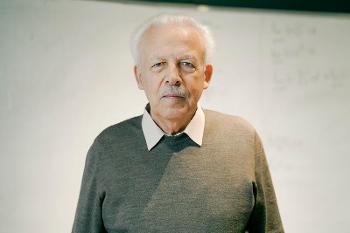
24 April is the 80th anniversary of Professor Vladimir Zadorozhny, DSc in Physics and Mathematics, Head of the Department of System Analysis and Management of VSU, member of the American Mathematical Society, whose career was guided by destiny. It seems as if all his life he’s been following a lucky star of mathematics, if there is such a star. Vladimir Zadorozhny believes that it is important to set yourself the most challenging tasks and that mathematics is a creative process rather than just science.
“How did mathematics come into your life?”
V.Z.: “I have always liked mathematics. I loved solving tricky problems “with an asterisk”. However, when I was at school, sciences were not my only passion, I also played in a professional wind band. We played every day at dance halls. After school, I wasn't planning to get a degree, I got a job instead. After all, I had five brothers, and I was a middle child and it was inconvenient to leave the family. However, a friend of mine, who was already studying at VSU, insisted that I should enter university. I couldn’t sleep all night and eventually submitted my documents to Voronezh State University. I received excellent marks in all three exams I had to sit and entered the Faculty of Mathematics.”
“What was your student life like?”
V.Z.: “I knew it was the right place for me. I was fascinated by mathematical problems. I was very lucky, in the second year, Professor Anatoly Perov taught differential equations to us. He gave me a challenging problem and I managed to solve it. As a result, my first article was published in the “Collection of works by undergraduate and postgraduate students”. Then it turned out that with my solution of this problem I was 10 years ahead of my colleagues from Italy.”
“When did you start to teach?”
V.Z.: “I was in the fifth year, it was the beginning of September, the very beginning of the school year. A friend of mine and I were walking along the corridor and Professor Mark Krasnoselsky was walking in the opposite direction. He saw us and shouted: “You're the ones I need now! There is a half-time teaching job at the Faculty of Chemistry, and a half-time teaching job at the Faculty of Mathematics. Which faculty do you want to work for?” We were confused. He took out a coin and flipped it. That's how I got a part-time job at the Faculty of Mathematics. You could say that it was luck.”
“What is mathematics: science or creativity?”
V.Z.: “It’s more like creativity, of course! In mathematics, you can set your own tasks. They become your passion. I think you have to choose difficult tasks for yourself. Our brain works in a very interesting way, it works even when we sleep. It can take a day, two, three days, and after a while you come up with an idea how to solve the problem. It's like testing your capabilities. It feels like you're running a long distance and you are one of the first.”
“How did it happen that you continued to work at VSU?”
V.Z.: I have always been very lucky to meet nice people. During my studies, I worked with Professor Anatoly Perov. I wrote my graduation paper and my reviewer was Anatoly Levin. It was simply impossible to get an excellent mark from him. He read my work and gave it a very good review. By the defence day, my classmates and I had already been allocated to our future jobs. I was persuaded to join a restricted-access enterprise in Klin. Everything had been decided. But Perov saw the review of my work and asked me: “Would you like to stay and work at the university?” I asked to take a 24 hour time-out to think it over but finally agreed.”
“You have been teaching at the university for many years. Do you have a secret about how to work with students?”
V.Z.: “There is no special secret. When you enter the classroom, the first five minutes are most important. Sometimes you can even tell a joke, and if you get the attention of the audience you set the ball rolling. Between 1972 and 1974, I taught at Martin Luther University in Germany. It was a business trip commissioned by the Ministry of Education of the USSR. I worked at the pre-university training department where classes lasted 45 minutes. It was even more tiring than working at the university. Then, I went to teach one group, then another group, and it started all over again! There is no universal secret, you need to look for one every time.”
“Do you have a motto?”
“Of course. My motto is “Do it your own way!”
Text: by Ekaterina Kochetova


