

Members of the Department of Biophysics and Biotechnology published a number of review papers in Biophysical Review, which is among the top 11 world Q1 journals in biophysics, according to the Scimago Journal & Country Rank website, which ranks publications indexed in Scopus or Web of Science databases.
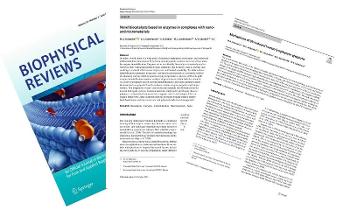
The review “Novel biocatalysts based on enzymes in complexes with nano- and micromaterials” by Marina Holyavka, Svetlana Goncharova, Yulia Redko, Maria Lavlinskaya, Andrey Sorokin, and Valery Artyukhov reflects the current state of development and prospects for hybrid biocatalysts based on natural enzymes and micro- and nanomaterials. Enzymes are natural catalysts that are much more efficient than their synthetic counterparts.
They are ideal for use in biotechnology, food industry, and medicine, non-toxic, and in line with the trend of sustainability and transition to a “green” industry. However, like many biological agents, they are characterised by low stability, a short storage period, and a lack of reusability. A promising solution to this problem is to fix enzymes on various micro- and nanomaterials with a large surface area, making the catalyst accessible to the reaction medium, ensuring its stability and cyclic use. In this study, the authors reviewed the main materials that are used for enzyme fixation: nanoparticles of metals and their oxides, metal-organic frame and porous structures, polymeric and magnetic particles, as well as nanoscale materials based on natural compounds (proteins, lipids, and polysaccharides). The authors paid special attention to the achievements of the department staff in terms of stabilisation of cysteine proteases (bromelain, papain, and ficin) using micro- and nanomaterials based on chitosan.
The review “Mechanisms of UV-induced human lymphocyte apoptosis” by Marina Nakvasina, Marina Holyavka, Valery Artyukhov, Maria Radchenko, and Olesya Lidokhova is devoted to the most important problem of cell biophysics, i.e. the establishment of regularities of cell death. The article summarises the results of long-term studies of the mechanisms and pathways of apoptotic death of human peripheral blood lymphocytes induced by UV radiation. Studying the mechanisms of cell death, identification of the markers of its types, and searching for ways to regulate them is crucial for understanding the patterns of morphogenesis and embryonic development, maintaining cell homeostasis, the biological effect of physico-chemical agents, the pathogenesis of various diseases, and the development of effective treatment methods.


