Prior to the Congress of Young Scientists, National University of Science and Technology “MISIS” held 3rd All-Russian School of Student Research Societies, which was the largest in Russia. Yulia Shershidskaya, a fourth year student from the Faculty of Geology of Voronezh State University, took part in the event.
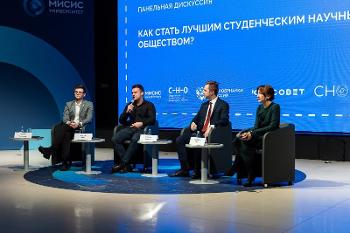

The school is aimed at developing Russian Student Research Societies, increasing their efficiency, and promoting science. This year, more than 700 people from 71 regions of Russia applied for participation in the School. The event was supported by the Ministry of Education and Science of Russia and the Coordination Council for the Youth Affairs in the Area of Research and Education.
The 3rd All-Russian School of Student Research Societies consisted of panel discussions, master classes, lectures, and project sessions aimed at discussing issues related to the support of Student Research Societies, the organisation of their activities, and the best practices of associations. The school started with a panel discussion “Support for Student Research Societies within the framework of the Decade of Science and Technology”. Among the participants of the discussion were representatives of the authorities and educational and public organisations.

“The main goal of the Decade of Science and Technology, formulated by the President of the Russian Federation, is to make the results of scientific activities more visible to the public. This is necessary for the development of the country and society and improvement in the standard of living. The work carried out by student research societies is important since it attracts to science people who share this ideology,” said Denis Sekirinsky, Deputy Minister of Science and Higher Education of the Russian Federation.
During the discussion, Alexander Mazhuga, First Deputy Chairman of the Committee for Education and Science of the State Duma of the Russian Federation, noted that Russian science is one of the youngest in the world. He emphasised that this aspect should remain unchanged in the future to secure achieving high-quality results.
“Student Research Societies is an important tool for attracting young people to science. In addition, the activities of student scientific societies meet all three objectives of the Decade of Science and Technology: attracting talented young people to science; engaging researchers in solving important problems; popularising science, which will make information about the achievements of scientists more easily available. Today, much is being done at the state level to support the Student Research Societies. For example, one of the sections of the budget for the three-year period is devoted to them. The budget for the state programme “Scientific and Technological Development of the Russian Federation” (as compared to FZ-466) has increased by 375 billion roubles this year. There are also housing certificates, a mega-grant programme, the “Mendeleev Map” project, and much more. I personally think that all these initiatives contribute a lot to engaging as many young people as possible in science. But, of course, we will do everything possible to increase the amount of support each year,” said Alexander Mazhuga.
Alevtina Chernikova, Rector of the MISIS National University of Science and Technology, gave examples of projects implemented at the university which are aimed at promoting research conducted by young scientists:
“One of the tasks of the higher education is to attract talented young people to science. The MISIS National University of Science and Technology promotes the image of scientists, opens laboratories headed by young researchers, and implements iPhD education programmes, which are focused on training researchers. It also has a student research society, in which students take their first steps in science. The projects of the MISIS National University of Science and Technology include the annual events “Days of Science”, the student grant contest “TurNIR”, Christmas lectures, the School of a Young Scientist, and much more.
At the end of the panel discussion, Nikita Marchenkov, Chairman of the Coordination Council for the Youth Affairs in the Area of Research and Education and the Head of the Kurchatov Complex for Synchrotron-Neutron Research at the Kurchatov Institute National Research Centre, gave a lecture in which he talked about the challenges and opportunities for young scientists within the framework of the Decade of Science and Technology.
“Today, young people have a lot of opportunities for their development in the field of science. It is a fact that young people are now able to quickly switch between tasks and this skill is high in demand in modern science because the speed of its development is constantly increasing. Every few years, new urgent challenges and tasks appear. You have to be able to adapt to a new situation, put aside what you have been doing and offer a solution to the problem in just a few months. Mankind, our country, and science face challenges that are as serious, important, and complex as the nuclear or space projects used to be. All of them require out-of-the box ideas and approaches from scientists,” said Nikita Marchenkov.
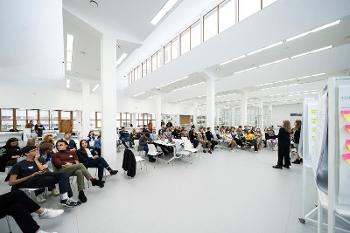
An important part of the programme were events dedicated to the exchange of experience and best practices by student research societies, which were attended by representatives of the Institute of Nuclear Energy of National Research Nuclear University Moscow Engineering Physics Institute, Moscow State Institute of International Relations, Gubkin University, Mechnikov Medical University, and others. The second day of the school was devoted to team project work within the main areas of activities of student research societies with the participation of facilitators and experts.
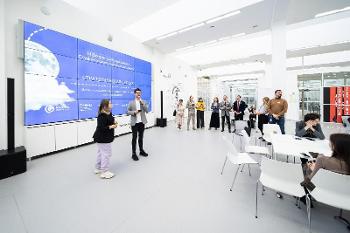
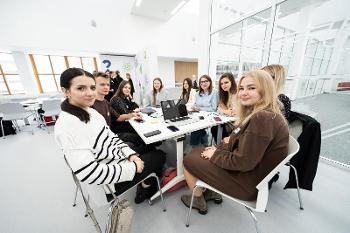
“Representatives of student research societies had the opportunity to ask questions to the members of the Coordination Council and the Duma. Organisers allocated time for such questions. At the end of the event, the guys shared the best practices implemented at their universities. There was a lot of time for communication, networking, and ideas generation within each topic.
The School of Student Research Societies at the MISIS National University of Science and Technology helped to outline the goals and the areas for further development,” said Yulia Shershidskaya, a fourth year student from the Faculty of Geology.
The President of the Russian Federation, Vladimir Putin, declared the years 2022–2031 the Decade of Science and Technology. This includes a set of initiatives, projects, and activities aimed at strengthening the role of science and technology in solving the most important tasks related to the development of society and the country.
Photo: Student Research Society at the MISIS National University of Science and Technology