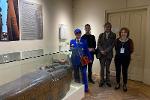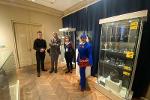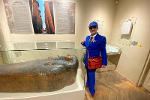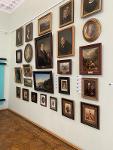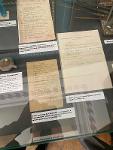
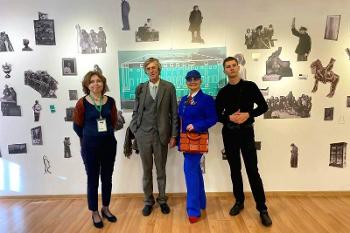
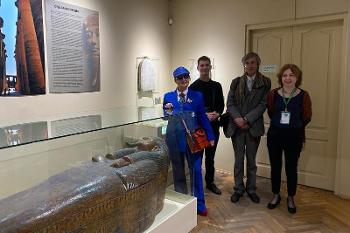
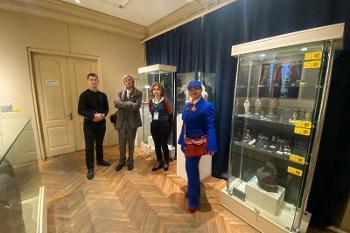
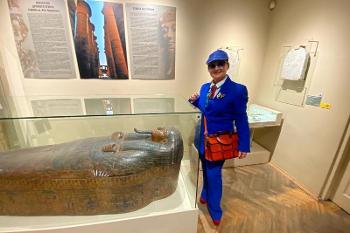
On November 10, on the eve of the 105th anniversary of Voronezh State University, the staff of the Museum and Exhibition Centre of VSU visited the Kramskoy Voronezh Regional Art Museum.
In March 1918, when Estonia had been occupied by the Kaiser’s army, the occupation government decided to turn the Yuriev University into a German educational institution curated by Emperor Wilhelm II. Thus, the university was in a critical situation. Russian teachers and students had nothing to live on and had to leave Estonia. They were anxious about the university’s fate and eager to return to Russia. It was decided to evacuate the university to one of the cities of Central Russia, and Voronezh was chosen as a suitable place to resume its activities.
In July and September 1918, 39 professors, 45 lecturers, 43 service staff members, and about 800 students arrived in Voronezh by special trains from Derpt (Yuriev). Among them were such famous scientists as physicians Nikolay Burdenko, Ivan Georgievsky, Valery Afanasiev, Sergey Mikhnov, Evgeny Nikolsky, and Aleksandr Yushchenko; biologists Ivan Shmalhausen, Konstantin St. Hilaire, and Mikhail Tsvet; geologists Nikolay Bogolyubov and Valery Tarasenko; jurists Vladimir Grabar and Lev Shalland; historians Vasily Regel, Pavel Yakovenko, and Anton Yasinsky; philologists Ernst Felsberg, Mikhail Krasheninnikov, Dmitry Kudryavsky, and Evgeny Petukhov; philosopher Yakov Oze; geophysicist and mechanic Leonid Leibenzon; and meteorologist Boris Sreznevsky. They all did great and fruitful work on the formation of the university in Voronezh.
As a rule, a classical university is a cultural centre. The Derpt University had a Museum of Antiquities and Arts. It also moved to Voronezh. The provincial town received a European university with long-standing traditions, values, lecturers, a library with an outstanding number of unique books, and the rarest exhibits of the Museum of Antiquities. Thus, the long-standing dream of educated local residents came true, there was now a university in Voronezh.
According to the Russian Museum Encyclopaedia, university museums are a group of specialised educational museums in different fields, which are created to improve the efficiency of the educational process. At the same time, they are research units, a base for students’ scientific research.
Until the 1930s, the University Museum of Antiquities and Arts was located at Voronezh University, and students could immerse themselves in the courses “History of World Culture” and “History of World Cultural Heritage” right in the university building. During the educational process, lecturers, using examples from the Museum’s Egyptian and antique collections and Western European paintings, introduced students to world masterpieces.
The Museum used to have a collection of antique vases. This collection was comparable to the best museum collections in the world. These were samples of most of the ancient Greek vessels: amphora, krater, oinochoe, kylix, and others, vessels with geometrical painting, black-figured and red-figured vases.
From 1918 to 1930, the museum functioned as part of the university. On December 8, 1931, the newspaper “Krasny Oktyabr (Red October)” published a message under the headline “The University Museum should be opened immediately”: “Everything that is available at VSU should be made accessible to workers and farmers, since it is interesting and useful for us to know the history of the development of the university, to learn in detail about the educational institution where we study.”
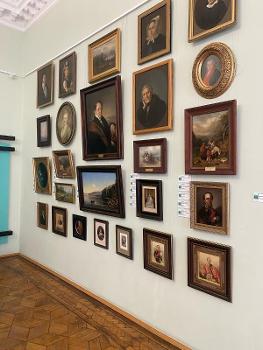
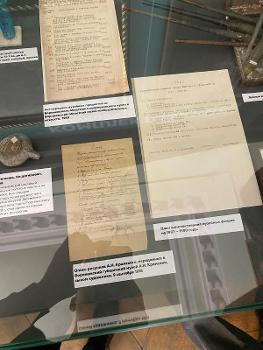
On January 15, 1933, a new Regional Art Museum was established on the basis of the university collection. Thus, the Museum of Antiquities and Arts of VSU was discontinued. At the same time, the Voronezh Regional Museum was established, now it bears the name of Ivan Kramskoi, a remarkable artist, a native of Ostrogozhsk.
The newly created museum also included the art collection of the former Provincial Museum. Subsequently, the funds have been replenished regularly. Today the Kramskoy Voronezh Regional Art Museum is the largest exhibition space in the region, and a lot of scientific and cultural work is carried out there. The VSU staff is proud that our university was involved in its foundation.