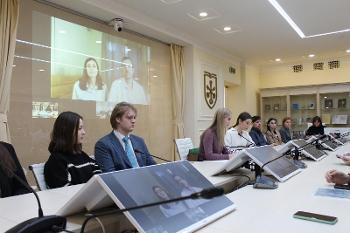
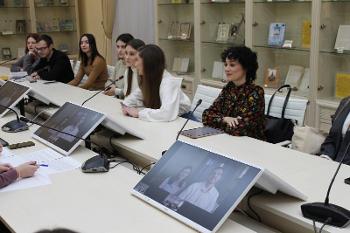
On 30 November, a meeting with Joseph and Svetlana Rose who relocated from the USA was held in the white hall of Voronezh State University. The meeting was attended by students from all faculties of VSU as well as other universities in Voronezh. It was organised by students and staff members of the Department of English Philology of the Faculty of Romance and Germanic Philology of VSU.
At the moment, we can see an interesting tendency: more and more Americans and Europeans are moving to Russia. Joseph and Svetlana have five children. Almost two years ago, on 16 February 2022, they decided to move from the USA to Russia. Svetlana Anokhina and her husband Joseph Rose believe that there are going to be more people like them once they get a first-hand account of what life in Russia is actually like. Today, people in the USA cannot get such information, so they ask Joseph a lot of questions, because he runs a video blog about Russian cities, towns, and villages. People in America have certain stereotypes, which are far from being true. Joseph pointed out that Russia is eager to support fair and sustainable development and is open to dialogue with anyone who shares traditional values.
“People in the West want to know the truth about Russia. They live in a different reality and want to leave it, but they can’t because it would cost them their jobs or even their lives. People ask us what they should do to move to Russia or at least to visit it”, said Svetlana.
The audience found the event very interesting and asked a lot of questions. For example, they asked about the way people from a different country were treated in Russia and if there were any communication problems. There were also questions about modern technologies in Russia and in other countries, the education system, infrastructure, clothes, and consumer prices. The audience also wanted to know what foreigners think about the Russian mentality.
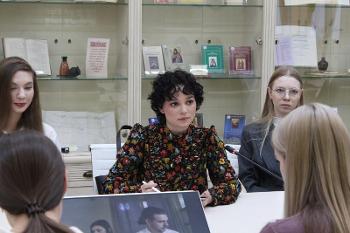
Sofia Volkova, a third year student from Voronezh State Forest Engineering University and an organiser of the Russian club Logos, shared her opinion about the event.
“Until today, I could not quite choose between two opposing points of view. When I was a teenager, I believed that life is better in the West, and I should seize any opportunity to move there. Then I started to have doubts. Svetlana and Joseph helped me to make the final decision. Now I realise that our proverb about doing your best in the country where you were born is not just words. We should value what we have and do our best to make our country better, rather than dream about wonderful life abroad, because it only seems wonderful until you get to live there.”
Elisaveta Perveeva, a first year student from the Faculty of Romance and Germanic Philology, liked a discussion between Evgeniya Martova, who dreams of moving to a western country, and her “opponents” Svetlana and Joseph.
“It was interesting to hear a first-hand account of what life is like in a different country: about the healthcare system, the education system, etc. On the other hand, it was also interesting what foreigners think of Russia, the pros and cons of living here. The speakers broke down all the stereotypes and shared some amusing facts about other countries. It would be great if our university organised more such events!”
“When I saw the ad, I signed up immediately, and I enjoyed the event a lot. It was a unique opportunity to learn about the pros and cons of immigration. It was very thought-provoking, and now I’m sure that living in a different country is not like living in a fairy tale”, said Egor Kamenev, a fourth year student from the Faculty of Romance and Germanic Philology. Svetlana Anokhina-Rose and her family are eager to help other potential migrants to open a dialogue with Russia.
She noted an interesting trend. People in western countries facing discrimination and aggressive liberal policies consider Russia as a place they could live in. Russia gives migrants a chance to get a good education and become highly-trained specialists, which in turn can help to address skills shortages in the Russian economy. To do this, it is necessary to remove the existing migration barriers.