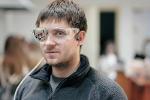

Viktor Alekseyev is a PhD student from the Faculty of Computer Science of VSU. He became interested in medical cybernetics when he was a second year bachelor's degree student. Since then, Viktor has conducted research under the supervision of Yaroslav Turovsky, DSc in Technical Sciences, PhD in Medicine, Professor at the Department of Digital Technologies, and the Head of the Laboratory of Medical Cybernetics of VSU. Currently, Viktor Alekseyev is a member of the research group at the Faculty of Computer Sciences and is working in cooperation with scientists from Trapeznikov Institute of Control Sciences of the Russian Academy of Sciences. They are studying the mutual adaptation of users and human-computer interfaces. In spring 2023, the research group won a grant from the Russian Science Foundation for developments in this field. Viktor Alekseyev is studying approaches to controlling devices by means of eye-tracking and myographic interfaces, as well as a brain-computer interface.
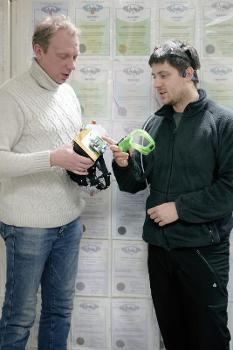
“Traditionally, we control devices with our hands and feet, but there are still a huge number of potential control channels, which are as accurate and can sometimes be faster. What’s more, sometimes traditional channels can’t be used. For example, if the person is paralysed. In this case, you can use different approaches to convey exactly what the user wants to the computer and the device controlled by it, for example, a wheelchair. In the laboratory, I chose a direction related to eye tracking systems in ergatic systems,” says Viktor Alekseyev.
Eye tracking systems are devices that monitor where the person’s gaze is directed by tracking the eye and head movements. And the ergatic system is a system which includes a human in its control loop.
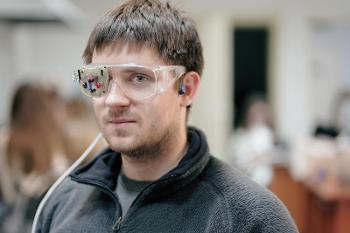
“We have developed glasses that use certain algorithms to track where a person is looking. This is the second generation of this type of device. The first one was developed by my namesake, Alexander Alekseyev, a leading engineer at the Laboratory of Medical Cybernetics at VSU. His glasses worked using video cameras. The new generation has a number of improvements: it no longer uses cameras, but much cheaper and compact devices. The programs of the device “remember” how a person looks at different points of the surrounding space. Thanks to this, eye tracking systems can calculate specific coordinates to which a person's gaze will be directed in the future. Another device is a camera which is also able to track human actions by means of 3D modelling,” said Viktor.
Viktor Alekseyev is using a grant under the UMNIK programme to develop a system allowing monitoring actions of a group of operators, this system is based on 3D cameras. They also need eye tracking systems.
“Let's imagine that each operator, for example, in production, has its own sector of responsibility within a large dashboard. We can often see such dashboards in news reports. And suddenly, an alarm indicator lights up on such a panel. Following the laws of psychophysiology, all operators turn their heads to this new and potentially dangerous signal, which stops them from observing their areas of responsibility. The system which I have developed allows monitoring such situations and sending signals when there are interruptions in work,” said Viktor. Researchers from the Laboratory of Medical Cybernetics closely cooperate with undergraduate and postgraduate students and lecturers of other specialities: medicine, chemistry, biology, psychology, mathematics, and electronics. Thanks to this, they have come up with many new and interesting ideas which have been transformed into software codes and hardware.
“Recently, I presented the project with regards to eye tracking systems at a regular seminar at the Faculty of Mechanics and Mathematics of Moscow State University. In general, my supervisor and I consider the platforms which have been developed and are being developed as one of the promising areas in improving the “human-technical device” interaction”, said Viktor.