
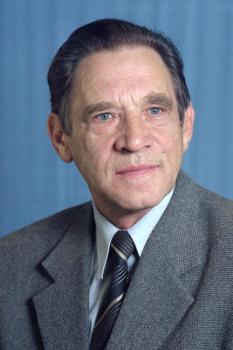
Stanislav Kadmensky, DSc in Physics and Mathematics, is a professor at the Department of Nuclear Physics. In 1979, he became the laureate of the international prize of the Joint Institute for Nuclear Research. In 2002, the scientist was awarded the title of Honoured Scientist of the Russian Federation. Stanislav Kadmensky and Archpriest Viktor Prazdnichny, Rector of the Holy Ascension Church in Voronezh, have written the book “Science and Religion”.
About the choice of the research area
I was lucky. I studied at a very good school in Voronezh which had wonderful teachers. By the 8th grade, I had already known which science I wanted to develop. I chose nuclear physics as my future profession. That was the time when the first books devoted to various areas of this science began to appear. I read them and took my time to digest them. Fortunately, the lessons at school were at a high level and I could understand many things even then.
About the importance of balanced development
In the 7–8th grade at school, I formed friendly bonds with children who later became doctors in mathematics, geology, chemistry, and other sciences. Some of my friends were wonderful poets. I'm glad that my social circle at school was like that. The Voronezh Palace of Pioneers played an important role in my development. I belonged to a dramatic reading club. We were taught by outstanding actors from the Voronezh Drama Theatre. They trained my voice and diction and gave me an understanding of how to speak when you are onstage.
When I studied at school and university, I belonged to various sports clubs. I did wrestling, skiing, and climbing. In the first year at the Faculty of Physics of Voronezh State University, I was interested in gliding. I could fly a glider for hours. For us, students, the world was an interesting place.
About creativity
People should set ambitious goals in life. This is the core of my perception of the world. I have always understood that money is not the centre of balance. Humans endowed with intellect and creative abilities were created by nature for something more ambitious.
When people are aimed at creativity, when they participate in creating something new, it does not matter whether it is a spacecraft or a lathe machine, this makes their work meaningful. Creativity is the most important thing in any career. If people have opportunities to be creative, they can be truly happy.
About an ideal university teacher
For a good university teacher, it is very important that their students have high-quality knowledge. A good mentor will do everything possible to achieve this. However, it is important to teach people to think out of the box. For example, in physics there are problems that can be solved in different ways. A student who is able to find a new solution to the problem is a student of the highest value.
You can apply someone else's approach and get a certain result. Although such work might also be useful, it will not be game-changing. To me, such studies seem less interesting than those in which there is at least one new idea, even though it is unlikely to compare with those of Einstein’s.
The teacher should strive not only to help students master the difficult material but to encourage them to add their own understanding. The teacher’s aspiration to share knowledge and teach students to be creative when solving problems is the most valuable for students.
About religion
Any person thinks about what they were born for and what humanity exists for. Does humanity have a purpose?
All natural scientists can be divided into two categories. Atheist scientists believe that everything in nature can be described naturally by using, first of all, the fundamental laws of physics. Another group of scientists is of the opinion that we and the world around us have properties that cannot be understood with the help of fundamental physical laws. I mean there are fundamental laws in the world that do not come down to physics.
The question is: do we know any experimental properties of our world that cannot be understood using fundamental physical laws?
In the 1960s, a new principle was discovered, the anthropic principle, according to which the main global physical constants in our Universe (for example, the speed of light, Planck’s constant, the charge and mass of electrons and nucleons that make up molecules, atoms, nuclei, and others), which physics uses, are adjusted with an enormous degree of accuracy in such a way that organic life was possible, including humans. If the value of a global constant changed even by a very small fraction, there would be no organic life in the Universe. All outstanding scientists agreed that such an accurate adjustment of global constants within the framework of physics cannot be accidental, so the anthropic principle was naturally associated with the existence of a “Supreme Mind” or, in other words, a “God” who created all the fundamental laws of our world, including the values of global physical constants.
The famous physicist Niels Bohr suggested that, in addition to physical laws, there are biotonic laws of nature in our world that allow for the existence of a “Supreme Mind”, which created our world with such laws.
My book “Science and Religion” analyses how modern science relates to the idea of the “Supreme Mind”. The existence of the “Supreme Mind” means that there might be some purpose for the existence of humans and human society. Obviously, these higher goals cannot only be associated with business and material things.


